{}
Get the full picture before you hire globally. Salaries, taxes, contributions, the lot. → Try our free calculator

HRIS Integrations: Workday & BambooHR Provider Guide

Global employment
This article is for informational purposes only and does not constitute legal, tax, or compliance advice. Always consult a qualified professional before acting on any information provided.

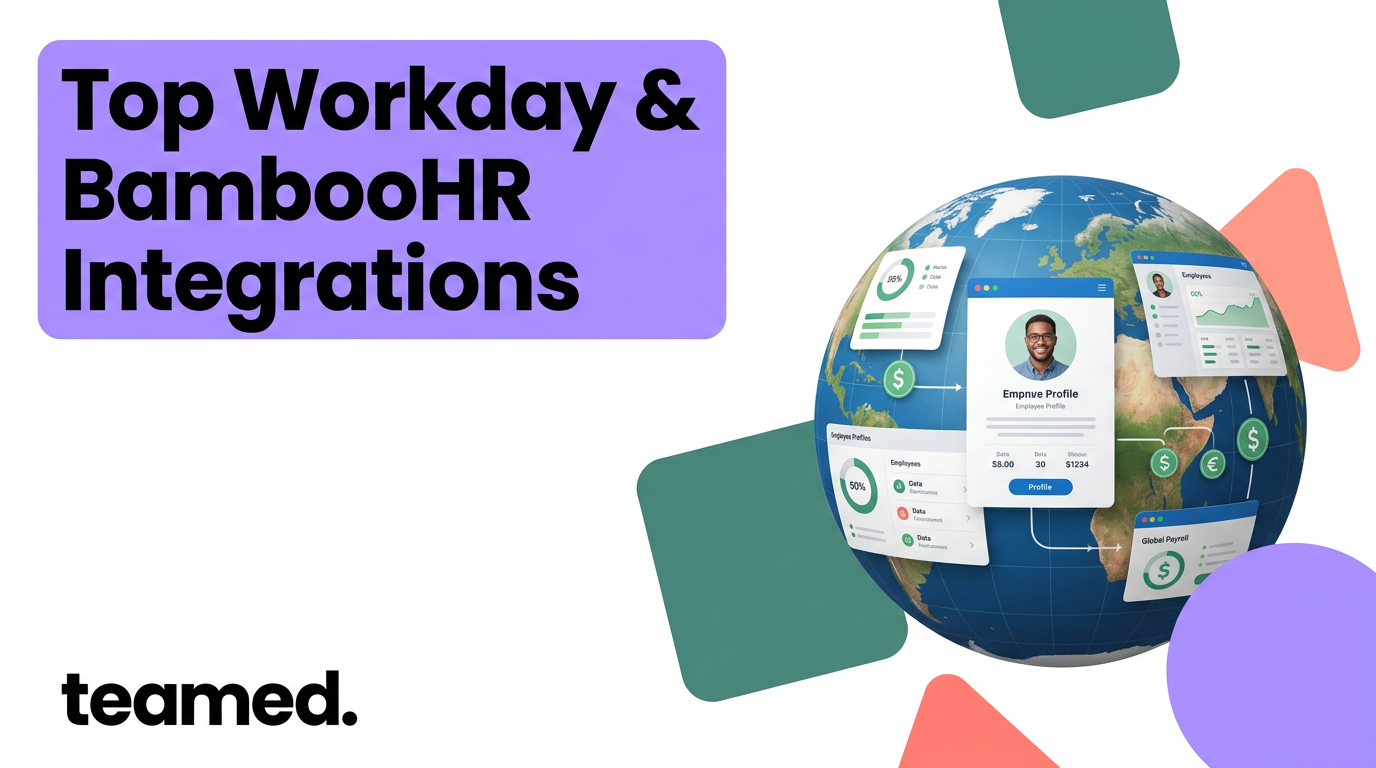
What Integrations Do the Best Providers Offer with Our Existing HRIS Like Workday or BambooHR?

You've spent months implementing Workday or BambooHR. Your team finally has a single source of truth for employee data. Now you're expanding internationally, and your EOR provider wants you to manually re-enter every hire into their system. Then do it again for payroll. And again for benefits.

This is the integration question that keeps VP People and HR Directors up at night. Not whether integrations exist, but whether they actually work the way your operations need them to. The difference between a native Workday connector and a file-based SFTP feed isn't just technical. It's the difference between your German hire appearing in payroll within hours versus discovering three weeks later that their tax ID was mapped to the wrong field.

Mid-market companies operating across 5-15 countries face a specific challenge here. You're too complex for the simple API connections that work for startups, but you don't have the integration team that enterprises deploy. Based on Teamed's work with over 1,000 companies navigating global employment, the integration decision often determines whether your HRIS remains your system of record or becomes just another data silo.

Quick Facts: HRIS Integration Capabilities in 2025

Global payroll and EOR integrations commonly involve 60-150 distinct data fields once country-specific statutory fields are included, covering tax identifiers, social insurance classes, and local address rules.

Workday's Enterprise Interface Builder (EIB) supports bulk data import and export on daily or intraday cadences, making it the standard for HR-to-payroll file scheduling.

BambooHR's public API now uses OAuth 2.0 authentication as the primary method with read and write access to key employee and time-off objects, reducing integration lead time compared to SFTP-only payroll feeds.

A mid-market multi-country rollout typically requires at least two parallel pay cycles to validate mapping and net pay outputs before go-live.

Integration support models meeting mid-market operational needs typically target 24-48 hour turnaround for mapping changes like new allowance codes or cost centres.

Event-driven integration designs using Workday business process events or BambooHR webhooks reduce stale employee records compared with weekly batch exports by narrowing updates to only changed fields.

Why Do HRIS Integrations Matter for Global Employment?

An HRIS integration is a secure, governed data connection that synchronises worker lifecycle events between your HRIS and downstream systems like global payroll, EOR platforms, benefits administration, and finance. When someone joins, changes role, or leaves, that information needs to flow accurately to every system that depends on it.

Without proper integrations, your HR team becomes a human middleware layer. According to Deloitte's 2025 global payroll benchmark, 70% of countries now use managed-services payroll models to reduce this manual burden.

The real cost isn't just administrative hours. It's the decisions you can't make because your data is fragmented. When your CFO asks for total employer cost by country, you're pulling from four systems and hoping the exchange rates align. When compliance asks for proof of statutory registration dates, you're searching email threads because that data never made it back to your HRIS.

What Workday Integration Options Do Leading Providers Offer?

A Workday integration uses Workday's object model and integration tooling to move HR master data and organisational structures into external payroll and EOR platforms with full auditability. Workday's Global Payroll Connect program now supports payroll delivery in 187 countries and territories through partner integrations.

Workday integration options differ from BambooHR compatible integrations because Workday commonly requires alignment to Workday business processes and objects. When an employee is hired in Workday, that triggers a business process with specific data elements. Your EOR or payroll provider needs to understand that object structure, not just receive a flat file of employee names.

The providers offering the most robust Workday integrations typically support bi-directional data flow. One-way HRIS-to-payroll integration minimises write-back risk to HRIS data integrity, but bi-directional flows improve HR reporting completeness by returning employment IDs, statutory status, and payroll outputs. If your compliance team needs to see that an employee's German social insurance registration completed successfully, that information should flow back to Workday automatically.

Choose a native Workday connector when you need Workday business process alignment for hire, transfer, and termination events and want Workday to remain the system of record with standard Workday integration governance. This matters particularly for companies in regulated industries where audit trails are non-negotiable.

Which BambooHR Integrations Work Best for Multi-Country Operations?

A BambooHR integration is a connector that uses BambooHR's API and webhooks to transfer employee profile, job, compensation, and time-off data to payroll and EOR systems. The field mappings are typically simpler than enterprise HCMs, which can be an advantage for mid-market companies without dedicated integration resources.

BambooHR's strength is accessibility. G2 reviewers consistently note that BambooHR is "super easy but limited once you need multi-state compliance or detailed reporting." For international operations, this means the integration itself is straightforward, but you need a provider who can handle the complexity on their end.

The best BambooHR compatible integrations for global employment support webhook-based event triggers with 50 standard employee fields rather than relying solely on scheduled batch exports.

Choose an API-first integration when HR operations require near-real-time onboarding status and frequent attribute changes without waiting for scheduled batch runs. This is particularly relevant for companies with high hiring velocity or frequent organisational changes.

How Should You Evaluate Integration Capabilities When Choosing a Provider?

Most pages ranking for HRIS integration providers list logos but don't specify which objects actually sync. A differentiating question to ask any provider is whether they can produce an explicit object-level checklist covering hire events, compensation changes, bank details, tax information, cost centre assignments, termination dates, and contract artifacts for each integration type.

The system of record question is critical and often overlooked. A system of record is the authoritative application that owns specific data fields and defines which system can create, update, or terminate records to prevent conflicting updates. Current Workday integration options content rarely explains these system-of-record decisions, but they determine whether your HRIS remains authoritative or becomes a secondary reference.

For mid-market companies, the practical evaluation criteria include several key factors. First, consider field coverage and whether the integration handles the 60-150 distinct data fields required for multi-country statutory compliance, or just basic employee demographics. Second, examine change control and whether mapping changes can be implemented within 24-48 hours, because HR teams frequently restructure during growth phases. Third, verify audit logging and whether every create, update, and terminate event is logged with timestamps, source system, and field-level deltas for compliance evidence.

A finance-ready global payroll integration typically produces at least three outputs per pay run: pay register, employer cost breakdown, and GL-ready journal lines. Payroll totals alone are insufficient for accruals and audit trails, so verify that your provider's integration supports your CFO's requirements, not just your HR team's.

What's the Difference Between EOR Integrations and Global Payroll Integrations?

An EOR-focused integration differs from a global payroll integration because EOR integrations must capture legal-employer actions like contract issuance, statutory registrations, and local benefits enrolment. Global payroll integrations primarily focus on calculation inputs and statutory reporting outputs.

This distinction matters because EOR providers are becoming your legal employer in each country. The integration needs to flow information both ways. Your HRIS sends the hire request with compensation details. The EOR system generates a locally compliant contract, registers the employee with statutory authorities, and enrols them in mandatory benefits. All of that information should flow back to your HRIS so you have a complete record.

Choose bi-directional sync when you must write back EOR employment identifiers, contract dates, statutory registrations, and termination dates into the HRIS to keep audit trails and reporting consistent across systems. This is particularly important for companies subject to SOX-like governance requirements, even outside the US.

In the UK, HMRC can assess payroll tax underpayments and associated interest for prior years, so integration audit logs and historical mappings become operationally important evidence during payroll-related queries and reviews. Your integration design should support this level of auditability from day one.

How Do Integration Requirements Change as Companies Graduate from EOR to Entity?

Few providers connect integrations to a structure roadmap, but this is where mid-market companies face the most friction. Teamed's Graduation Model describes the natural progression companies follow as they scale international teams, moving from contractors to EOR to owned entities as headcount and commitment in each market grows.

The integration challenge is that most providers force you to re-platform at each transition. You build an integration with your EOR provider, then when you establish your own entity in Germany at the 15-20 employee threshold, you need to tear down that integration and build a new one with a local payroll provider. Then you're managing two different integration patterns, two different data flows, and two different support relationships.

A GEMO (Global Employment Management Operations) approach eliminates this fragmentation. GEMO means one supplier manages global employment from initial EOR hiring through entity transition and ongoing entity management, eliminating the need to switch providers at each stage. The integration architecture remains consistent even as the underlying employment model evolves.

For mid-market companies operating in 5-15 countries simultaneously, coordinating separate EOR providers, entity formation specialists, local payroll vendors, and compliance consultants creates significant overhead. Teamed's analysis shows this often costs £50,000-£150,000 annually in coordination costs alone. A single supplier with GEMO capability eliminates this fragmentation and maintains integration continuity throughout your growth journey.

What Integration Architecture Works Best for Mid-Market Global Operations?

Choose an iPaaS-based approach when you must integrate more than three systems and want reusable transformations and monitoring across all flows. An iPaaS (Integration Platform as a Service) is middleware like Workato, Boomi, or MuleSoft that standardises authentication, transformation, retries, and monitoring across multiple HR and finance integrations without custom code per system.

A native connector differs from an iPaaS build because a native connector usually ships pre-mapped objects and vendor support, while an iPaaS build provides broader flexibility across systems but places more design ownership on the buyer. For mid-market companies without dedicated integration teams, native connectors with vendor support typically deliver faster time-to-value.

Identity and access management designs that enforce least-privilege typically limit HRIS-to-payroll integrations to 1-3 service accounts with scoped permissions rather than individual user credentials. This security consideration becomes important when your integration handles sensitive data like bank details and tax identifiers across multiple countries.

EU GDPR requires data minimisation in HRIS integrations, meaning a Workday or BambooHR integration should not transmit fields like health data or diversity data to payroll or EOR unless there is a documented necessity and appropriate safeguards. Your integration design should include field-level controls to ensure compliance with data protection requirements across all jurisdictions.

What Questions Should You Ask Providers About Their HRIS Integrations?

The right questions reveal whether a provider's integration capabilities match your operational reality. Start with object-level specificity. Ask which Workday business processes or BambooHR objects trigger data flows, and which fields are included in each direction. A provider who can't answer this question in detail likely doesn't have a mature integration offering.

Ask about change control turnaround times. When you add a new cost centre or allowance code, how quickly can the mapping be updated? The 24-48 hour benchmark reflects what mid-market operations actually need during growth phases. Anything longer creates bottlenecks that compound across pay cycles.

Verify audit and compliance capabilities. Can the provider produce a complete audit log showing every data change, timestamp, source system, and field-level delta? For companies in regulated industries or those subject to finance governance requirements, this isn't optional.

Finally, ask about the graduation path. What happens to your integration when you transition from EOR to your own entity in a country? If the answer involves re-platforming and rebuilding, factor that cost and disruption into your evaluation.

Making the Integration Decision

The integration question isn't really about technology. It's about whether your global employment operations will scale with your business or become a constraint on growth. The right structure for where you are means an integration architecture that supports your current HRIS while providing trusted advice for where you're going.

Mid-market companies deserve integration capabilities that match their complexity without requiring enterprise resources to implement and maintain. That means native connectors with vendor support, bi-directional data flows that keep your HRIS authoritative, and a provider who understands that your integration needs will evolve as you graduate from EOR to entities in key markets.

If you're evaluating providers and want to understand how integration capabilities fit into a broader global employment strategy, talk to an expert at Teamed. We'll help you map your current integration requirements against your growth trajectory and identify the architecture that supports both.
What Integrations Do the Best Providers Offer with Our Existing HRIS Like Workday or BambooHR?

You've spent months implementing Workday or BambooHR. Your team finally has a single source of truth for employee data. Now you're expanding internationally, and your EOR provider wants you to manually re-enter every hire into their system. Then do it again for payroll. And again for benefits.

This is the integration question that keeps VP People and HR Directors up at night. Not whether integrations exist, but whether they actually work the way your operations need them to. The difference between a native Workday connector and a file-based SFTP feed isn't just technical. It's the difference between your German hire appearing in payroll within hours versus discovering three weeks later that their tax ID was mapped to the wrong field.

Mid-market companies operating across 5-15 countries face a specific challenge here. You're too complex for the simple API connections that work for startups, but you don't have the integration team that enterprises deploy. Based on Teamed's work with over 1,000 companies navigating global employment, the integration decision often determines whether your HRIS remains your system of record or becomes just another data silo.

Quick Facts: HRIS Integration Capabilities in 2025

Global payroll and EOR integrations commonly involve 60-150 distinct data fields once country-specific statutory fields are included, covering tax identifiers, social insurance classes, and local address rules.

Workday's Enterprise Interface Builder (EIB) supports bulk data import and export on daily or intraday cadences, making it the standard for HR-to-payroll file scheduling.

BambooHR's public API now uses OAuth 2.0 authentication as the primary method with read and write access to key employee and time-off objects, reducing integration lead time compared to SFTP-only payroll feeds.

A mid-market multi-country rollout typically requires at least two parallel pay cycles to validate mapping and net pay outputs before go-live.

Integration support models meeting mid-market operational needs typically target 24-48 hour turnaround for mapping changes like new allowance codes or cost centres.

Event-driven integration designs using Workday business process events or BambooHR webhooks reduce stale employee records compared with weekly batch exports by narrowing updates to only changed fields.

Why Do HRIS Integrations Matter for Global Employment?

An HRIS integration is a secure, governed data connection that synchronises worker lifecycle events between your HRIS and downstream systems like global payroll, EOR platforms, benefits administration, and finance. When someone joins, changes role, or leaves, that information needs to flow accurately to every system that depends on it.

Without proper integrations, your HR team becomes a human middleware layer. According to Deloitte's 2025 global payroll benchmark, 70% of countries now use managed-services payroll models to reduce this manual burden.

The real cost isn't just administrative hours. It's the decisions you can't make because your data is fragmented. When your CFO asks for total employer cost by country, you're pulling from four systems and hoping the exchange rates align. When compliance asks for proof of statutory registration dates, you're searching email threads because that data never made it back to your HRIS.

What Workday Integration Options Do Leading Providers Offer?

A Workday integration uses Workday's object model and integration tooling to move HR master data and organisational structures into external payroll and EOR platforms with full auditability. Workday's Global Payroll Connect program now supports payroll delivery in 187 countries and territories through partner integrations.

Workday integration options differ from BambooHR compatible integrations because Workday commonly requires alignment to Workday business processes and objects. When an employee is hired in Workday, that triggers a business process with specific data elements. Your EOR or payroll provider needs to understand that object structure, not just receive a flat file of employee names.

The providers offering the most robust Workday integrations typically support bi-directional data flow. One-way HRIS-to-payroll integration minimises write-back risk to HRIS data integrity, but bi-directional flows improve HR reporting completeness by returning employment IDs, statutory status, and payroll outputs. If your compliance team needs to see that an employee's German social insurance registration completed successfully, that information should flow back to Workday automatically.

Choose a native Workday connector when you need Workday business process alignment for hire, transfer, and termination events and want Workday to remain the system of record with standard Workday integration governance. This matters particularly for companies in regulated industries where audit trails are non-negotiable.

Which BambooHR Integrations Work Best for Multi-Country Operations?

A BambooHR integration is a connector that uses BambooHR's API and webhooks to transfer employee profile, job, compensation, and time-off data to payroll and EOR systems. The field mappings are typically simpler than enterprise HCMs, which can be an advantage for mid-market companies without dedicated integration resources.

BambooHR's strength is accessibility. G2 reviewers consistently note that BambooHR is "super easy but limited once you need multi-state compliance or detailed reporting." For international operations, this means the integration itself is straightforward, but you need a provider who can handle the complexity on their end.

The best BambooHR compatible integrations for global employment support webhook-based event triggers with 50 standard employee fields rather than relying solely on scheduled batch exports.

Choose an API-first integration when HR operations require near-real-time onboarding status and frequent attribute changes without waiting for scheduled batch runs. This is particularly relevant for companies with high hiring velocity or frequent organisational changes.

How Should You Evaluate Integration Capabilities When Choosing a Provider?

Most pages ranking for HRIS integration providers list logos but don't specify which objects actually sync. A differentiating question to ask any provider is whether they can produce an explicit object-level checklist covering hire events, compensation changes, bank details, tax information, cost centre assignments, termination dates, and contract artifacts for each integration type.

The system of record question is critical and often overlooked. A system of record is the authoritative application that owns specific data fields and defines which system can create, update, or terminate records to prevent conflicting updates. Current Workday integration options content rarely explains these system-of-record decisions, but they determine whether your HRIS remains authoritative or becomes a secondary reference.

For mid-market companies, the practical evaluation criteria include several key factors. First, consider field coverage and whether the integration handles the 60-150 distinct data fields required for multi-country statutory compliance, or just basic employee demographics. Second, examine change control and whether mapping changes can be implemented within 24-48 hours, because HR teams frequently restructure during growth phases. Third, verify audit logging and whether every create, update, and terminate event is logged with timestamps, source system, and field-level deltas for compliance evidence.

A finance-ready global payroll integration typically produces at least three outputs per pay run: pay register, employer cost breakdown, and GL-ready journal lines. Payroll totals alone are insufficient for accruals and audit trails, so verify that your provider's integration supports your CFO's requirements, not just your HR team's.

What's the Difference Between EOR Integrations and Global Payroll Integrations?

An EOR-focused integration differs from a global payroll integration because EOR integrations must capture legal-employer actions like contract issuance, statutory registrations, and local benefits enrolment. Global payroll integrations primarily focus on calculation inputs and statutory reporting outputs.

This distinction matters because EOR providers are becoming your legal employer in each country. The integration needs to flow information both ways. Your HRIS sends the hire request with compensation details. The EOR system generates a locally compliant contract, registers the employee with statutory authorities, and enrols them in mandatory benefits. All of that information should flow back to your HRIS so you have a complete record.

Choose bi-directional sync when you must write back EOR employment identifiers, contract dates, statutory registrations, and termination dates into the HRIS to keep audit trails and reporting consistent across systems. This is particularly important for companies subject to SOX-like governance requirements, even outside the US.

In the UK, HMRC can assess payroll tax underpayments and associated interest for prior years, so integration audit logs and historical mappings become operationally important evidence during payroll-related queries and reviews. Your integration design should support this level of auditability from day one.

How Do Integration Requirements Change as Companies Graduate from EOR to Entity?

Few providers connect integrations to a structure roadmap, but this is where mid-market companies face the most friction. Teamed's Graduation Model describes the natural progression companies follow as they scale international teams, moving from contractors to EOR to owned entities as headcount and commitment in each market grows.

The integration challenge is that most providers force you to re-platform at each transition. You build an integration with your EOR provider, then when you establish your own entity in Germany at the 15-20 employee threshold, you need to tear down that integration and build a new one with a local payroll provider. Then you're managing two different integration patterns, two different data flows, and two different support relationships.

A GEMO (Global Employment Management Operations) approach eliminates this fragmentation. GEMO means one supplier manages global employment from initial EOR hiring through entity transition and ongoing entity management, eliminating the need to switch providers at each stage. The integration architecture remains consistent even as the underlying employment model evolves.

For mid-market companies operating in 5-15 countries simultaneously, coordinating separate EOR providers, entity formation specialists, local payroll vendors, and compliance consultants creates significant overhead. Teamed's analysis shows this often costs £50,000-£150,000 annually in coordination costs alone. A single supplier with GEMO capability eliminates this fragmentation and maintains integration continuity throughout your growth journey.

What Integration Architecture Works Best for Mid-Market Global Operations?

Choose an iPaaS-based approach when you must integrate more than three systems and want reusable transformations and monitoring across all flows. An iPaaS (Integration Platform as a Service) is middleware like Workato, Boomi, or MuleSoft that standardises authentication, transformation, retries, and monitoring across multiple HR and finance integrations without custom code per system.

A native connector differs from an iPaaS build because a native connector usually ships pre-mapped objects and vendor support, while an iPaaS build provides broader flexibility across systems but places more design ownership on the buyer. For mid-market companies without dedicated integration teams, native connectors with vendor support typically deliver faster time-to-value.

Identity and access management designs that enforce least-privilege typically limit HRIS-to-payroll integrations to 1-3 service accounts with scoped permissions rather than individual user credentials. This security consideration becomes important when your integration handles sensitive data like bank details and tax identifiers across multiple countries.

EU GDPR requires data minimisation in HRIS integrations, meaning a Workday or BambooHR integration should not transmit fields like health data or diversity data to payroll or EOR unless there is a documented necessity and appropriate safeguards. Your integration design should include field-level controls to ensure compliance with data protection requirements across all jurisdictions.

What Questions Should You Ask Providers About Their HRIS Integrations?

The right questions reveal whether a provider's integration capabilities match your operational reality. Start with object-level specificity. Ask which Workday business processes or BambooHR objects trigger data flows, and which fields are included in each direction. A provider who can't answer this question in detail likely doesn't have a mature integration offering.

Ask about change control turnaround times. When you add a new cost centre or allowance code, how quickly can the mapping be updated? The 24-48 hour benchmark reflects what mid-market operations actually need during growth phases. Anything longer creates bottlenecks that compound across pay cycles.

Verify audit and compliance capabilities. Can the provider produce a complete audit log showing every data change, timestamp, source system, and field-level delta? For companies in regulated industries or those subject to finance governance requirements, this isn't optional.

Finally, ask about the graduation path. What happens to your integration when you transition from EOR to your own entity in a country? If the answer involves re-platforming and rebuilding, factor that cost and disruption into your evaluation.

Making the Integration Decision

The integration question isn't really about technology. It's about whether your global employment operations will scale with your business or become a constraint on growth. The right structure for where you are means an integration architecture that supports your current HRIS while providing trusted advice for where you're going.

Mid-market companies deserve integration capabilities that match their complexity without requiring enterprise resources to implement and maintain. That means native connectors with vendor support, bi-directional data flows that keep your HRIS authoritative, and a provider who understands that your integration needs will evolve as you graduate from EOR to entities in key markets.

If you're evaluating providers and want to understand how integration capabilities fit into a broader global employment strategy, talk to an expert at Teamed. We'll help you map your current integration requirements against your growth trajectory and identify the architecture that supports both.
TABLE OF CONTENTS

Take a look
at the latest articles