
Compliance
2026 Canada Labour Code Changes: Remote Hiring Rules

Teamed Legal

12 min

Mar 26, 2026
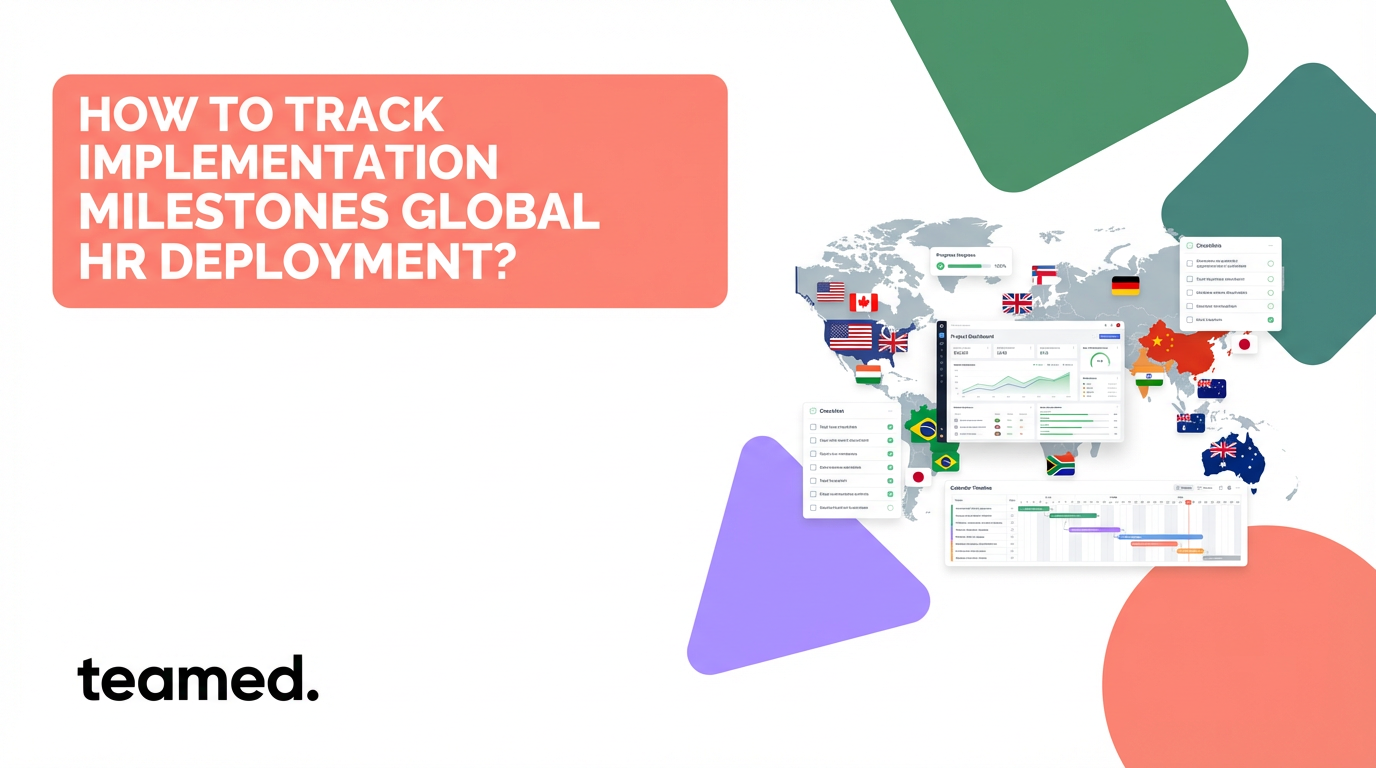
You're rolling out HR systems across five countries simultaneously. Germany's works council consultation is stalling. The Netherlands payroll configuration is two weeks behind. Your Spain team just discovered a missing statutory registration. And nobody can tell you which delays actually threaten your go-live dates because the tracking lives in three spreadsheets, two project management tools, and someone's email inbox.
This is the reality for most mid-market companies deploying global HR systems. The problem isn't a lack of milestones. It's that milestone tracking becomes meaningless without clear ownership, evidence requirements, and escalation triggers that work across jurisdictions.
Teamed's GEMO (Global Employment Management and Operations) delivery benchmarks show that a practical mid-market global HR deployment takes 12-24 weeks for a single-country payroll and HR operating model, and 6-12 months for a multi-country rollout of 5-10 jurisdictions. The difference between hitting those timelines and watching them slip by months often comes down to how you track progress.
A milestone tracker is only operationally reliable when at least 95% of in-scope milestones have a named owner and a dated acceptance criterion.
A country go-live checklist typically contains 40-80 line items when it includes payroll setup, statutory registrations, benefits enrolment, employment-contract localisation, works-council checks, and data-protection controls.
Mid-market HR programmes commonly hold weekly operational stand-ups (30-45 minutes) and a steering committee every 2-4 weeks (45-60 minutes) during implementation.
A robust payroll parallel run typically requires at least 2 consecutive pay cycles of matched net pay within a defined tolerance before cutover.
A workable rollout cadence for mid-market Europe and UK deployments is 1-2 countries per month after the pilot go-live.
Any milestone that is more than 10 working days late or more than 5 working days blocked should trigger escalation to the steering committee.
Global HR deployment is a cross-country implementation programme that standardises core people processes (hiring, payroll, benefits, time, and offboarding) while preserving required local legal and tax rules in each jurisdiction. The complexity comes from the tension between wanting consistency across your organisation and needing to comply with wildly different regulatory requirements in each country.
An implementation milestone is a binary, evidence-based checkpoint that is considered complete only when defined acceptance criteria and audit-ready artefacts exist. This distinction matters because most tracking failures happen when teams mark milestones complete based on activity rather than outcome. "Payroll configuration started" is a task. "Payroll configuration tested with two parallel runs showing net pay variance under 1%" is a milestone.
The difference between a milestone and a task is the difference between knowing you're on track and hoping you're on track. When your CFO asks whether you'll hit the Germany go-live date, you need evidence, not optimism.
The milestones that matter fall into five categories, and missing any of them can derail your entire rollout. Here's what you're actually tracking.
Before you configure anything, you need statutory registrations complete in each country. In Germany, this means employer registration for payroll tax and social security processes. In the Netherlands, you need compliant employment documentation aligned with Dutch labour law and mandatory holiday allowance practices of at least 8% of gross annual salary. These aren't administrative formalities. They're legal prerequisites that block everything downstream.
Data migration planning belongs here too. A defensible approach is to sample-test at least 10-20% of migrated employee records per country against source-of-truth fields (name, address, tax IDs, salary, start date, bank details) before go-live. Discovering data quality issues during parallel runs is expensive. Discovering them after go-live is catastrophic.
Payroll configuration milestones need specific acceptance criteria tied to local requirements. France payroll implementations must account for mandatory payslip information requirements and common collective bargaining agreement rules that affect working time, allowances, and employee classifications. Spain implementations must reflect statutory requirements that impact payroll and time tracking, including social security contributions and specific termination documentation practices.
The parallel run milestone deserves special attention. Many Europe and UK teams use a tolerance of plus or minus 1% on net pay variances for like-for-like scenarios. Running old and new payroll side-by-side for at least two consecutive pay cycles is the fastest way to detect configuration errors before employees are paid incorrectly.
A compliance gate is a formal go/no-go control point that blocks a country go-live until statutory prerequisites are met. This includes tax and social security registration, compliant employment terms, and data-protection controls. The difference between a compliance gate and a soft launch is the difference between defensibility and liability.
GDPR applies to HR data processing for employees in the EU/EEA and UK, with potential fines of up to £17.5 million or 4% of annual turnover. Your deployment must document a lawful basis for processing, role-based access controls, retention periods, and cross-border transfer safeguards where applicable. This isn't a checkbox. It's a milestone with specific evidence requirements.
The go-live checklist for a single country typically runs 40-80 line items. This includes final payroll validation, benefits enrolment confirmation, employment contract distribution, works council sign-off where required, and data protection controls verification. Each item needs an owner, a due date, and documented evidence of completion.
The first three payroll cycles after go-live are milestones, not business as usual. You're validating that everything works under real conditions. Track variance rates, support ticket volumes, and time-to-resolution for issues. These metrics tell you whether your implementation actually succeeded or whether you just moved problems from one system to another.
Choose a single global milestone tracker when you have more than three countries in flight. Multi-tool tracking using email, spreadsheets, and local trackers prevents reliable dependency management and audit evidence collection. The tool matters less than the discipline of using one system as the single source of truth.
A milestone tracker is a single system-of-record (such as Jira, Asana, MS Project, or Smartsheet) that links each HR project milestone to an owner, due date, dependencies, risks, and documentary proof of completion. The key word is "links." Your tracker should connect milestones to the evidence that proves they're actually complete.
Every milestone needs a named owner, not a team. When Germany's works council consultation stalls, you need to know exactly who is accountable for unblocking it. A practical minimum documentation standard for audit-readiness is one stored artefact per milestone for 100% of compliance-critical milestones. This means registration confirmations, signed policies, configuration screenshots, test evidence, or legal approvals.
Your tracker should also capture dependencies explicitly. The Netherlands payroll configuration can't complete until statutory registrations are done. If you don't map that dependency, you'll discover it when someone asks why payroll is two weeks behind and nobody can explain it.
Manual HR deployment tracking differs from automated tracking because manual tracking relies on human updates and is prone to stale statuses. Automated tracking can enforce required fields (owner, due date, dependency) and attach evidence to each milestone. The automation doesn't need to be sophisticated. Even requiring a file attachment before a milestone can be marked complete eliminates most of the "I thought it was done" conversations.
This is the question that derails most global HR deployments. You want standardised processes across your organisation, but Germany requires works council consultation, France has extensive labour code requirements, and Spain has rigid collective bargaining rules. The answer isn't choosing one over the other. It's building a framework that accommodates both.
A country-based tracker differs from a process-based tracker because country-based tracking highlights jurisdictional dependencies (registrations, local benefits, language), while process-based tracking highlights end-to-end workflow readiness (hire-to-pay, time-to-pay, termination-to-final-pay). Most mid-market companies need both views. Your steering committee wants to know if Germany is on track. Your implementation team needs to know if payroll configuration is complete across all countries.
Choose wave-based deployments when at least two countries share the same payroll provider, language, or regional policy set. Shared configuration and documentation reduces duplicated milestone effort. A workable rollout cadence for mid-market Europe and UK deployments is 1-2 countries per month after the pilot go-live. Parallelising more than three countries typically increases dependency clashes between legal review, payroll configuration, banking, and data migration.
A steering committee differs from an implementation stand-up because a steering committee exists to resolve cross-functional decisions (scope, budget, risk acceptance) while stand-ups exist to remove blockers and update milestone status. You need both, and they serve different purposes.
Weekly operational stand-ups should run 30-45 minutes and focus on blocked milestones, upcoming dependencies, and immediate risks. The steering committee meets every 2-4 weeks for 45-60 minutes and handles decisions that require cross-functional alignment. When your Germany works council consultation requires a scope change that affects budget, that's a steering committee decision, not a stand-up discussion.
A RACI matrix is a governance tool that assigns who is Responsible, Accountable, Consulted, and Informed for each global HR implementation deliverable. This prevents gaps between HR, Finance, Legal, IT, and local stakeholders. The most common failure mode isn't missing milestones. It's milestones that nobody owns because everyone assumed someone else was handling them.
A common control threshold in multi-country HR implementations is to treat any milestone that is more than 10 working days late or more than 5 working days blocked as an escalation event for the steering committee. This sounds simple, but most organisations don't define these thresholds until they're already in trouble.
Choose a dedicated implementation owner per country when local legal steps require in-country coordination (registrations, benefits brokers, works councils, or local policy consultation). Central teams cannot reliably unblock local dependencies without a named local lead. This is especially true in Germany, where works council consultation may be required once a business has at least 5 permanent employees when HR systems materially change how employee data is processed or how performance and time data is monitored.
Your deployment timeline depends heavily on whether you're implementing for employees on EOR (Employer of Record), contractors, or your own entities. Each model has different milestone requirements and compliance gates.
Teamed's Graduation Model describes the natural progression companies follow as they scale international teams, from contractors to EOR to owned entities. The model matters for deployment tracking because each stage has different compliance requirements. EOR employees need different onboarding documentation than direct employees. Entity establishment adds statutory registration milestones that don't exist for EOR arrangements.
Choose a pilot-country-first rollout when you are implementing a new global HR operating model. A single pilot reveals data, payroll, and contract localisation issues before they multiply across jurisdictions. The pilot should be a country where you have strong local support and relatively straightforward compliance requirements. The UK is often a good choice for UK-headquartered companies because of the predictable legal framework and English operating language.
For companies approaching the crossover point where entity establishment becomes more cost-effective than EOR, deployment planning should include entity formation milestones. Tier 1 countries like the UK, Ireland, and the Netherlands typically require 2-4 months for entity establishment. Tier 2 countries like Germany, France, and Spain require 4-6 months. These timelines include entity incorporation, banking setup, tax registration, and employee transfer processes.
The best tool is the one your team will actually use consistently. That said, certain capabilities matter more than others for global HR deployment.
Dependency mapping is non-negotiable. Your tool must show which milestones block other milestones. Evidence attachment is essential for audit readiness. You need to store registration confirmations, test results, and sign-offs alongside the milestones they validate. Role-based access matters when you have local teams, central teams, and external advisors all working in the same tracker.
Choose a compliance-gated go-live process when your Legal and Compliance team must sign off statutory registrations, employment terms, and GDPR controls. A soft go-live creates retroactive tax and employment-law exposure. Your tracker should support formal approval workflows, not just status updates.
Choose parallel payroll runs when switching payroll providers or systems. Running old and new payroll side-by-side is the fastest way to detect configuration errors before employees are paid incorrectly. Your tracker should capture parallel run results as milestone evidence, including variance reports and reconciliation documentation.
The failures that derail global HR deployments are predictable. Unowned milestones behave like risks rather than plans. When nobody is specifically accountable for Germany's works council consultation, it drifts until it becomes a crisis.
Milestones without acceptance criteria create false confidence. "Payroll configured" means nothing without specific test results. "Payroll configured with two parallel runs showing net pay variance under 1% for 100% of employees" is a milestone you can actually verify.
Missing evidence creates audit exposure. When your auditors ask how you validated GDPR compliance for your Netherlands deployment, "we checked the box in our tracker" isn't an acceptable answer. One stored artefact per compliance-critical milestone is the minimum standard.
Tracking implementation milestones in global HR deployment isn't about having more milestones or fancier tools. It's about clear ownership, evidence-based completion criteria, and governance structures that surface problems before they become crises.
The organisations that execute global HR deployments successfully share common practices. They use a single tracker as the source of truth. They define acceptance criteria before work begins. They escalate blocked milestones quickly. And they treat compliance gates as non-negotiable checkpoints, not suggestions.
If you're planning a global HR deployment and want to understand how your employment structure affects your timeline, book your Situation Room. We'll review your current setup and help you build a milestone framework that accounts for the specific compliance requirements in each of your markets.
Switching from an Employer of Record to a Professional Employer Organisation when you already have a legal entity fundamentally shifts statutory employer liability from the EOR to your own company. This isn't a vendor swap. It's a transfer of legal responsibility that exposes your entity to direct payroll tax audits, employment claims, and regulator correspondence in that country.
Here's the thing most providers won't tell you: having a legal entity doesn't mean your entity is payroll-operational, nor does it automatically resolve permanent establishment considerations. Registration status, payroll capability, and employment-law governance are three distinct go/no-go gates. Missing any one of them during transition creates compliance gaps that can take months to resolve and cost significantly more than the savings you expected from the switch.
Teamed is the trusted global employment expert for companies who need the right structure for where they are, and trusted advice for where they're going. We've guided over 1,000 companies through these exact transitions, and the pattern is consistent: companies that treat EOR-to-PEO as a simple handover get burned. Companies that understand the liability shift and plan accordingly come out ahead.
UK HMRC can assess unpaid payroll taxes for up to 6 years, extending to 20 years for deliberate behaviour, meaning payroll errors during transition remain financially live long after cutover.
Mid-market companies typically require 6-12 weeks to complete an end-to-end EOR-to-entity payroll readiness cycle including registrations, payroll setup, and parallel run.
A compliant EOR-to-PEO handover generally requires at least one full parallel payroll run to validate statutory deductions, payslip compliance, and payment files before cutting over.
European HR and payroll processes commonly rely on 10+ separate employee-data fields that are compliance-critical, and missing any one can invalidate filings or contracts.
An EOR-to-PEO transition typically introduces at least two new regulated data flows compared with an EOR model, increasing GDPR accountability points and vendor oversight requirements.
CFO-led audit readiness typically requires reconciling three financial layers: gross-to-net payroll, employer on-costs, and vendor fees, because EOR invoicing often bundles costs differently than entity payroll ledgers.
An Employer of Record is a third-party organisation that becomes the legal employer of a worker in a given country and assumes primary responsibility for local payroll, tax withholding, statutory benefits, and employment-law compliance while you direct day-to-day work. A Professional Employer Organisation supports your HR, payroll operations, and benefits administration while your own legal entity remains the legal employer and retains direct statutory responsibility for employment compliance.
The distinction matters enormously. Under an EOR arrangement, the EOR issues employment contracts in its own name, handles terminations as the legal employer, and stands between you and local regulators. Under a PEO-supported entity model, your company issues the employment contract, your entity is the named filer for payroll tax and social security, and your company receives direct correspondence from labour inspectorates and tax authorities.
This isn't a subtle difference. It's the difference between having a buffer and being directly exposed.
Most companies assume that because they've registered a legal entity, they can simply "switch on" PEO support and start running payroll. This assumption creates the majority of compliance failures Teamed sees in transition scenarios.
A legal entity is a locally registered company that can contract with employees, register for payroll tax and social security, and be directly audited and sanctioned by local authorities for employment non-compliance. But registration alone doesn't mean you have payroll tax registrations completed, social security accounts established, bank accounts configured for salary payments, or the internal controls to sign off on payroll runs.
Consider a UK company that established a German GmbH six months ago for commercial purposes. The entity exists, but it may not have registered with the Finanzamt for wage tax, established a Betriebsnummer for social security (which requires choosing from 839 economic subclasses), or set up a German bank account for salary disbursement. Moving employees from an EOR to this entity without completing these steps means the first payroll run fails, employees don't get paid on time, and the company faces immediate regulatory scrutiny.
Teamed's GEMO operating-risk mapping identifies three distinct readiness gates: registration status, payroll capability, and employment-law governance. All three must be green before cutover.
An EOR-to-PEO transition creates a compliance risk window where the worker's employing entity, payroll processor, and benefits administrator may change on different dates. When these dates aren't synchronised, you get uninsured periods, unpaid social contributions, or incorrect tax withholding.
The most common failure pattern involves benefits continuity. An employee's health insurance terminates with the EOR on the 31st, but the entity's group policy doesn't activate until the 3rd of the following month. That three-day gap creates uninsured exposure that, depending on jurisdiction, can trigger both employee claims and regulatory penalties.
In Germany, works councils must be involved in certain HR measures where a works council exists. An EOR-to-entity move that changes employer, policies, or operational processes can require consultation or co-determination steps depending on the measure. Companies that skip this step face injunctions that halt the entire transition.
France requires a compliant payslip format with specific mandatory information. Non-compliant bulletin de paie practices trigger labour inspection issues, with employers facing fines of up to €450 per payslip not properly delivered. When you move from EOR-issued payslips to entity payroll, the localisation of payslip content becomes a critical control point that many companies overlook.
Switching from an EOR to a PEO shifts statutory employer liability from the EOR to your own legal entity. This typically increases your direct exposure to payroll tax audits, employment claims, and regulator correspondence in that country.
Under an EOR model, payroll registrations and filings sit under the EOR's local setup. The EOR is the named filer. Under a PEO model, your legal entity must hold the payroll tax and social security registrations and be the named filer where applicable. This means any errors in calculation, late filings, or incorrect withholding become your entity's problem, not the EOR's.
In the UK, employers must keep payroll records for at least 3 years after the end of the tax year they relate to. This creates a minimum multi-year evidence burden when migrating payroll responsibility. If your EOR didn't maintain adequate records, or if records don't transfer cleanly, you inherit a documentation gap that becomes visible only during an HMRC audit.
Employment claims work similarly. EOR offboarding is executed by the EOR as legal employer. PEO offboarding is executed by your entity. Legal review of notice periods, protected-category rules, and severance obligations becomes a client-owned control point. If your HR team isn't prepared to own termination compliance in Germany or France, you're taking on risk you may not be equipped to manage.
A compliant EOR-to-PEO transition follows a structured sequence that separates registration, capability, and governance readiness.
Step 1: Confirm entity registrations are complete. This means payroll tax registration, social security registration, and any industry-specific registrations required in that jurisdiction. In the Netherlands, this means timely wage tax (loonheffingen) and social security reporting capability through local payroll processes. In Spain, it means correct employee registration and contract documentation to avoid disputes over seniority, category, or termination entitlements.
Step 2: Establish payroll capability. This includes bank account setup, payroll software configuration, and validation that you can actually run a compliant pay cycle. Most companies underestimate this step. Payroll isn't just calculation; it's statutory reporting, payslip generation, and payment file creation that meets local banking requirements.
Step 3: Run a parallel payroll cycle. Teamed's GEMO transition methodology requires at least one full parallel payroll run to validate statutory deductions, payslip compliance, and payment files before cutting over. This catches calculation errors, missing data fields, and process gaps before they affect employees.
Step 4: Synchronise effective dates. The employee's employment contract transfer, payroll cutover, and benefits enrolment must align. A cutover timeline that prevents uninsured periods and incorrect statutory deductions requires explicit date coordination across all three workstreams.
Step 5: Transfer documentation and evidence trails. Employment files, payroll records, and compliance documentation must transfer from the EOR to your entity's systems. Under GDPR, this introduces new regulated data flows that require lawful basis mapping and international transfer assessments.
Most EOR vs PEO comparisons ignore data protection operational risk entirely. This is a significant oversight.
Under the EU General Data Protection Regulation, administrative fines can reach up to €20 million or 4% of annual worldwide turnover, with EU authorities issuing over €1.2 billion in fines in 2024 alone. Employee-data transfers during an EOR-to-PEO migration can create material compliance exposure even when payroll is correct.
An EOR-to-PEO transition typically introduces at least two new regulated data flows compared with an EOR model: entity payroll processing and entity benefits enrolment. Each new data flow requires clarity on controller vs processor roles, data processing agreements with vendors, and potentially a Data Protection Impact Assessment if the processing is high-risk.
The practical implication: you need to map which employee data transfers from the EOR's systems to your entity's systems, confirm lawful basis for that transfer, and ensure your PEO and any other vendors have appropriate data processing agreements in place. Companies that treat this as an afterthought face regulatory exposure that dwarfs the operational complexity of the payroll transition itself.
Choose a PEO-supported entity model when you already have a registered legal entity and can register locally for payroll tax and social security under your own name without relying on a third-party's registrations. Choose it when HR requires direct control over contracts, policies, and approvals and is prepared to own the legal sign-off process. Choose it when the country headcount is stable enough that you can justify building internal controls for payroll sign-off, statutory reporting, and employment file retention.
Choose an EOR over a PEO when you cannot yet obtain local employer registrations in time for the intended start date and the business needs legally compliant employment before the entity is operationally ready. Choose it when Legal/Compliance requires the third party to be the legal employer to ring-fence certain day-to-day employment compliance tasks during early market entry. Choose it when the company cannot reliably operate local employment lifecycle compliance in-country and needs a provider-led structure temporarily.
The Graduation Model, Teamed's proprietary framework for guiding companies through sequential employment model transitions, provides continuity across these decisions through a single advisory relationship. Rather than treating EOR-to-entity as a cliff where you lose your provider and start over, the Graduation Model maintains institutional knowledge and accountability throughout the transition.
UK TUPE (Transfer of Undertakings (Protection of Employment) Regulations 2006) can apply when employees transfer between employers as part of a business transfer or service provision change. Moving workers from an EOR employer to your UK entity can trigger mandatory information and consultation duties in applicable scenarios. Companies that don't assess TUPE applicability face employee claims and potential injunctions, with tribunals able to award up to 13 weeks' uncapped gross pay per affected employee for consultation breaches.
UK IR35 rules require medium and large organisations to assess off-payroll worker status. HMRC can assess unpaid tax liabilities for up to 6 years, making contractor-to-employee or EOR-to-entity restructures a high-scrutiny area. If your EOR arrangement involved any workers who might be characterised as contractors, the transition is an opportunity for HMRC to examine historical status determinations.
In France, the standard limitation period for recovering unpaid social security contributions is generally 3 years, extended to 5 years in certain situations. This makes backdated corrections a material risk when changing the operating model midstream. If your EOR made calculation errors, those errors may become your entity's liability to resolve.
CFO-led audit readiness for an EOR-to-PEO shift typically requires reconciling three financial layers: gross-to-net payroll, employer on-costs, and vendor fees. EOR invoicing often bundles costs differently than entity payroll ledgers, creating reconciliation challenges that surface during financial audits or due diligence processes.
Teamed's Three Layers of Opacity framework identifies the three ways the EOR industry obscures costs: hidden FX margins, bundled compliance fees, and undisclosed in-country partner markups. When you transition to your own entity, these bundled costs unbundle, and you need to understand what you were actually paying for to budget accurately going forward.
The documentation requirements extend beyond payroll. A document-level control list covering payroll reports, employment files, DPIAs, vendor DPAs, and record-retention requirements is essential for an EU/UK audit-ready transition. Most sources gloss over evidence and audit trails, but this is where transitions fail during subsequent due diligence or regulatory examination.
Switching from an EOR to a PEO when you have a legal entity isn't a vendor swap. It's a fundamental change in who bears legal responsibility for employment compliance. Your entity becomes directly exposed to payroll tax audits, employment claims, and regulatory correspondence. The transition window creates specific risks around benefits continuity, data protection, and documentation transfer that require explicit planning to manage.
The companies that navigate this successfully treat the transition as a project with distinct readiness gates, not a simple handover. They confirm entity registrations are complete, establish payroll capability, run parallel cycles, synchronise effective dates, and transfer documentation systematically.
If you're considering this transition and want to understand exactly what it means for your specific situation, book a Situation Room session. We'll review your current setup and tell you what we'd recommend, whether that includes us or not. The right structure for where you are, trusted advice for where you're going.
You've just acquired a team of 15 engineers in the Netherlands, where the tax wedge reaches 35.1% for average single workers. The board wants them employed properly within 30 days. You don't have a Dutch entity, and setting one up would take months you don't have.
This is the moment most mid-market companies discover Employer of Record services. Teamed is the trusted global employment expert for companies who need the right structure for where they are, and trusted advice for where they're going, from first hire to your own presence in-country. An Employer of Record is a third-party legal employer that hires workers on its local entity, runs compliant in-country payroll and statutory benefits, and assumes employment-law obligations while the client company directs day-to-day work.
But here's what most EOR guides won't tell you: the real complexity isn't understanding what an EOR does. It's knowing when EOR is the right answer, when it stops being the right answer, and how to avoid the hidden costs that erode your budget without ever appearing on an invoice.
Standard in-country EOR onboarding for a single employee is commonly completed in 5-15 business days once right-to-work checks, agreed compensation, and compliant benefits selections are finalised.
EOR commercial pricing for mid-market Europe and UK commonly includes a fixed per-employee-per-month fee plus pass-through statutory costs, with fixed fees most often sitting in the €300-€800 per employee per month band depending on country complexity and benefit design.
UK HMRC can assess underpaid tax liabilities for up to 4 years in standard cases and up to 6 years for careless behaviour, with a 20-year window where deliberate behaviour is found.
The effective all-in cost of employment is often materially higher than base salary once employer social charges, statutory benefits, insurance, and paid leave are included, with non-wage costs accounting for 25.5% of total labour costs in the euro area.
EOR programs become operationally harder to govern once a company has employees across 5+ countries because payroll cut-offs, statutory filing calendars, and benefit renewals vary by jurisdiction.
An EOR becomes the legal employer of your workers in countries where you don't have your own entity. The EOR signs the employment contract, runs local payroll under its registrations, handles statutory tax and social filings, and manages compliant termination support. You direct the day-to-day work. The EOR handles everything that makes employment legally compliant in that jurisdiction.
This arrangement differs fundamentally from contractor engagement. EOR is designed for employment relationships with statutory benefits and employment protections. Contractor engagement is designed for independent businesses and carries misclassification exposure if the facts resemble employment. Teamed's analysis of mid-market deployments across Europe and UK shows that misclassification risk is one of the primary drivers pushing companies from contractors to EOR.
The operational reality involves far more than payroll processing. Employment terms in Europe frequently require locally compliant written contracts covering working time, pay frequency, holiday entitlement, and probationary conditions. EOR templates must be local-law specific rather than a single global contract format. Right-to-work verification is a country-specific compliance requirement, and the EOR must complete local checks before employment starts to avoid illegal working penalties.
The compliance burden of international employment is substantial and jurisdiction-specific. Many European jurisdictions require specific termination processes and mandatory notice periods, which makes "at-will" style termination language non-compliant for Europe-based employment contracts. An EOR absorbs this complexity by maintaining local legal expertise and updated contract templates for each jurisdiction.
Consider a UK company expanding into Germany. German works councils become mandatory at 5+ employees if employees request them. Complex dismissal protection kicks in after 6 months. Notice periods range from 4 weeks to 7 months based on tenure. An EOR with genuine German expertise handles these requirements without you needing to become a German employment law specialist.
GDPR requires a written data processing agreement when an EOR processes HR personal data on a client's behalf as a processor. The agreement must define processing instructions, security measures, and sub-processor controls for cross-border HR operations. Administrative fines for certain GDPR infringements can reach up to €20 million or 4% of worldwide annual turnover, whichever is higher.
The primary cost advantage of EOR is avoiding entity establishment costs and ongoing entity administration burden. Entity formation and local payroll setup in many European jurisdictions takes weeks to months rather than days. For companies testing a new market or managing a small team in a single country, EOR eliminates the upfront investment and ongoing overhead of maintaining a legal entity.
Scalability works in both directions. You can add employees in new countries within days rather than months. You can also exit markets without the complexity of winding down a legal entity. This flexibility is particularly valuable during M&A integration, market testing, or when headcount in a country is uncertain.
But here's the honest answer: EOR isn't always the cheapest option long-term. Every EOR customer has a crossover point where the per-head cost of EOR exceeds the amortised cost of setting up and administering their own entity. Teamed's Crossover Economics methodology helps companies identify when entity setup becomes the lower-cost structure based on country-specific employer on-costs, provider fees, and one-off entity formation costs.
An EOR differs from a PEO in that an EOR is the legal employer on its own local entity, while a PEO typically supports a client that remains the legal employer on the client's entity. This distinction matters enormously for companies without existing local presence.
A Professional Employer Organization is a co-employment provider that usually requires the client to have a local entity and shares certain HR administration responsibilities rather than acting as the sole legal employer. If you don't have an entity in Germany, a PEO can't help you employ someone there. An EOR can.
Choose an EOR when you need to hire in a European or UK country within the next 30 days and you don't have, or don't want to maintain, a local employing entity in that country. Choose a PEO when you already have a local employing entity and you want outsourced HR administration support without transferring the legal employer role to a third party.
The risk allocation also differs significantly. EOR providers typically contractually limit liability and require client cooperation on compliant HR decisions. Entity employment concentrates statutory liability directly with the company and increases the need for in-house or retained local counsel. Understanding this distinction helps you evaluate what you're actually buying when you engage an EOR.
Choose an EOR when legal and compliance teams require a single accountable legal employer for local contracts, payroll, and statutory filings while the business tests a new market or post-acquisition footprint. The speed advantage is substantial. You can have employees on payroll in a new country within days rather than the months required for entity establishment.
Choose a local entity when you expect to employ 10+ people in the same country for 12+ months and you need direct control over local benefits, equity plan execution, or works council processes, while managing permanent establishment considerations. Some enterprise customers require contracting with local entities. Certain IP structures require own entities. Direct bank account control may be needed.
Teamed's Graduation Model provides a framework for this decision. The model describes the natural progression companies follow as they scale international teams, from contractors to EOR to entity. The optimal transition point varies by country complexity. Low-complexity countries like the UK, Ireland, and Singapore justify entity setup at 10+ employees. High-complexity countries like Brazil, India, and China may warrant staying on EOR until 25-35+ employees.
Stay on EOR if you're in your first 1-2 years in a new market while validating product-market fit, if the regulatory environment is unstable, or if you lack local HR and legal expertise. The EOR fee effectively serves as an insurance premium against labour court battles and compliance errors in high-complexity jurisdictions.
Most EOR selection advice focuses on features and pricing. But the real differentiator is what happens when something goes wrong. EOR termination support in Europe routinely requires country-specific notice periods and statutory separation steps. Offboarding lead time is a critical timeline risk because employment end dates are frequently constrained by local mandatory notice rules.
Start with the provider's actual presence in your target countries. Some EOR providers operate through undisclosed in-country partner networks rather than their own entities. This creates a layer of opacity between you and the people managing your employees' compliance. Ask directly: do you operate your own entity in this country, or do you subcontract to a local partner?
Examine the invoice structure carefully. Teamed's Three Layers of Opacity framework identifies the three ways the EOR industry obscures costs: hidden FX margins, bundled compliance fees, and undisclosed in-country partner markups. FX and funding mechanics are a material driver of EOR total cost because many providers invoice in a base currency while payroll is paid in local currency. Undisclosed FX spreads and conversion timing are one of the most frequent causes of invoice variance in Europe and UK multi-country EOR programs.
Demand line-item breakdowns. A CFO should be able to see exactly what they're paying for: base salary, employer social contributions, statutory benefits, provider fee, and any currency conversion costs. If a provider can't or won't provide this breakdown, that's a red flag.
The biggest pitfall is optimising for onboarding speed while ignoring offboarding complexity. Most EOR guides don't explain termination and offboarding risk. In Europe, notice periods, mandatory process steps, and documentation requirements drive timeline and cost outcomes more than onboarding speed. A provider that can onboard in 24 hours but takes three months to resolve an offboarding in Finland isn't actually serving your interests.
Another common mistake is assuming all EOR providers offer equivalent compliance coverage. Some providers route complex cases to chatbots or offshore queues. When you're dealing with a works council dispute in Germany or a redundancy process in France, you need someone who picks up the phone and knows the answer.
Choose a consolidated global employment partner when you operate across multiple European jurisdictions and need consistent controls for onboarding, payroll approvals, data processing, and offboarding across all countries under one governance model.
EOR programs become operationally harder to govern once a company has employees across 5+ countries. Payroll cut-offs, statutory filing calendars, and benefit renewals vary by jurisdiction. Teamed's GEMO (Global Employment Management and Operations) approach treats multi-country calendar management as a core control for audit readiness.
The right tracking approach depends on your scale and complexity. For companies with fewer than 20 international employees, a well-structured spreadsheet tracking payroll dates, contract renewals, and compliance deadlines may suffice. Beyond that threshold, you need integrated visibility across your entire international workforce.
Look for platforms that consolidate contractors, EOR employees, and owned entities in a single view. The goal is making strategic employment decisions with complete information, not reconciling data across multiple systems. Your CFO should be able to model "gross-to-total-employer-cost" by country rather than comparing salaries alone when evaluating EOR versus entity economics.
This is the question most EOR providers are structurally incentivised never to answer. Every month past the crossover point is pure margin for them.
Choose to graduate from EOR to entity when your forecast shows sustained in-country hiring and the economics indicate entity run-costs plus local payroll are likely to undercut EOR fees within a defined payback period. For a UK company with 10 employees, the break-even point often arrives around month 17 when comparing EOR fees of approximately £7,500 per employee per year against entity costs of approximately £3,500 per employee per year plus £25,000 setup costs.
The Graduation Model isn't about leaving EOR. It's about evolving beyond it when the numbers support the transition. A provider aligned with your interests will proactively surface this conversation rather than hoping you never ask the question.
The global employment industry profits from keeping companies where they are. Providers benefit when customers stay in the same structure whether it's right for them or not.
The right approach is different. You need the right structure for where you are today, and trusted advice for where you're going. That means honest guidance on when EOR makes sense, when entity establishment becomes the better answer, and how to execute transitions without compliance disasters.
If you're managing international employment across multiple countries and wondering whether your current structure is still serving you, book your Situation Room. Tell us your setup, and we'll tell you what we'd recommend, whether that includes us or not.
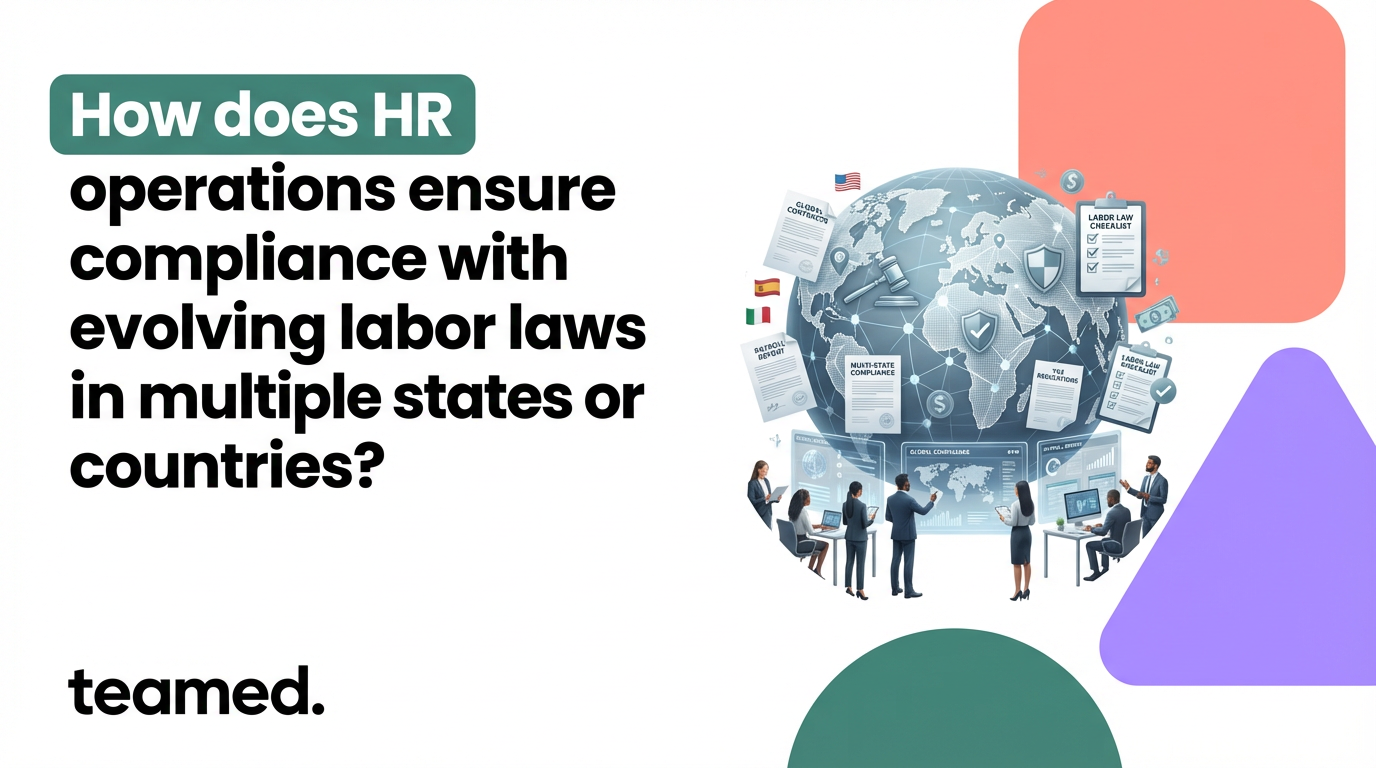
Your team just acquired 15 employees in the Netherlands, you've got contractors in California who probably should be employees, and Germany's works council rules are about to apply because you crossed the five-employee threshold last month. Meanwhile, France changed its payroll reporting requirements again, and nobody flagged it until the deadline passed.
This is the reality of HR operations compliance with labor laws across multiple jurisdictions. Teamed is the trusted global employment expert for companies who need the right structure for where they are, and trusted advice for where they're going. The challenge isn't understanding that laws differ between California and California-the-country-sized-Germany. The challenge is building operational systems that catch changes before they become compliance failures, document decisions in ways that survive audits, and scale without requiring a legal team in every country.
Most guidance on multistate labor law compliance and international HR compliance tells you to "stay updated on laws" without explaining how. This article provides the operational framework HR leaders actually need.
In the Netherlands, employers must continue paying at least 70% of wages during sickness for up to 104 weeks, making local cost modelling essential before hiring.
UK off-payroll working (IR35) assessments can reach back 6 years for unpaid income tax and National Insurance contributions, plus interest and penalties.
Germany's unlawful employee leasing, which occurs when assignments exceed 18 consecutive months, can trigger administrative fines reaching €500,000 under the Temporary Agency Workers Act (AÜG).
Spain requires companies to keep daily records of specific start and end times for all employees, making time tracking a compliance requirement rather than an HR preference.
France requires employers with 11 or more employees to organise Social and Economic Committee (CSE) elections, affecting consultation timelines and change management, while Germany requires works councils at just five employees.
When we're called in after a compliance scare, we see the same three failures: employment contracts missing mandatory local clauses, payroll filings that stopped happening when someone left, and contractor arrangements with zero documentation about why they're contractors.
Labor law compliance is an HR operations discipline that ensures hiring, contracting, payroll, time, leave, benefits, and termination practices meet the mandatory employment rules of each jurisdiction where people work. The key word is "where people work" rather than where your headquarters sits.
This distinction matters because remote work creates local payroll, social security, and employment rights exposure even when the employer is headquartered elsewhere. A UK company with an employee working from their apartment in Barcelona has Spanish employment law obligations, not British ones. Teamed's operating guidance treats "where the work is performed" as the primary jurisdiction trigger for employment law obligations.
Multistate labor law compliance applies when employees are located in different sub-national jurisdictions, such as US states or Swiss cantons, and HR must meet both national and local requirements without conflicts. International HR compliance extends this to country-level rules on contracts, working time, statutory benefits, tax and social security, employee representation, and termination processes.
The operational mechanism HR needs isn't a policy document. It's an auditable legal-change intake workflow with owners, effective dates, evidence artifacts, and rollback plans.
A compliance control library is a structured catalogue of jurisdiction-specific HR requirements mapped to HR processes, owners, evidence, and review dates. For each country where you employ people, this includes payslip fields, probation rules, notice periods, statutory leave entitlements, and mandatory benefits.
Consider a 400-person UK company expanding into Germany, Spain, and the Netherlands. Their control library would document that Germany requires written employment contracts before the start date, Spain caps probation at 6 months for qualified technicians and 2 months for others, and the Netherlands requires 70% salary continuation during sickness for up to 104 weeks.
Each entry needs an owner, a source document, an effective date, and a review trigger. Without this structure, policy updates happen by email, templates drift out of compliance, and audit evidence becomes impossible to reconstruct.
Here's the workflow that works: alerts come from local counsel or your provider, someone qualified decides if it affects you, templates and payroll settings get updated by deadline, and you file the decision and proof somewhere findable.
Teamed's operating guidance recommends documenting every jurisdiction change in a single compliance decision record that includes rule source, effective date, impacted populations, and rollback plan. Evidence quality often determines audit outcomes, not whether you eventually got the rule right.
Choose a quarterly compliance review cadence when you have employees in five or more countries. Legal changes cluster around annual budget cycles, statutory rate changes, and new reporting obligations. Quarterly reviews catch these before they become problems.
Both mean juggling different rules, but US states pile complexity through accumulation while countries hit you with completely different systems. One's death by a thousand cuts, the other's navigating parallel universes.
Multistate programs usually share one tax and social security system. California, Texas, and New York all operate within the US federal framework for Social Security and Medicare, even though state-level employment laws vary dramatically. International programs require separate registrations, statutory benefit schemes, and payroll reporting per country.
California presents particular complexity within the US context. Meal and rest break compliance, final pay on termination day, and extensive leave entitlements create requirements that exceed federal standards significantly. New York adds its own layers. Companies with employees spread across five or more US states face cumulative compliance burden that often justifies staying on an Employer of Record longer than headcount alone would suggest.
The structural decision layer matters here. Teamed's Graduation Model frames cross-border hiring choices as a progression from Contractor to EOR to Entity, positioning compliance risk as the primary driver of graduation when headcount, permanence, and local control increase. Sometimes changing the employment structure removes entire categories of compliance exposure.
Global policy templates and local contract templates serve different purposes. Policies can often be standardised with local addenda, while employment contracts usually require country-specific mandatory clauses to be enforceable.
UK employers must provide a written statement of employment particulars from day one of employment under the Employment Rights Act 1996. Germany's Posted Workers rules require foreign employers posting workers to Germany to meet German minimum wage and certain working condition requirements. France's Code du travail creates extensive procedural requirements for termination that don't exist in at-will US states.
Choose a single global HR policy framework with local addenda when you must standardise ethics, data handling, and approvals. Jurisdiction-specific employment rules typically require localised appendices rather than entirely separate global policies. This approach maintains consistency where possible while accommodating mandatory local variations.
EU GDPR applies to HR data processing and requires a lawful basis, data minimization, and appropriate technical and organisational measures. Cross-border transfers require mechanisms such as Standard Contractual Clauses when data leaves the UK or EU. Data protection compliance intersects with employment compliance in ways that require coordinated governance.
Teamed's compliance methodology treats country-level payroll compliance as a three-part control set: registration, calculation, and reporting. Failures typically occur in one of these three stages rather than in payroll processing itself.
Registration failures happen when you employ someone in a jurisdiction without proper employer registration. Calculation failures occur when statutory contributions, tax withholdings, or benefit accruals use incorrect rates or formulas. Reporting failures mean you calculated correctly but filed late, filed incorrectly, or failed to retain documentation.
Reactive compliance tracking updates templates after issues arise. Proactive compliance governance assigns owners, effective dates, and evidence requirements before the rule is enforced. The difference determines whether audits find documentation gaps or documented decisions.
Auditors look for missing local contract clauses, incomplete payroll statutory reporting, and undocumented worker classification rationales. These are the easiest gaps to evidence because they either exist in your files or they don't.
Worker classification assessments require particular attention. A documented test determines whether a person should be treated as an employee or independent contractor based on local legal criteria such as control, substitution, integration, and economic dependency. Choose a contractor arrangement only when the individual can genuinely control how and when work is delivered, can substitute another person to do the work, and is not managed as an integrated team member.
UK IR35 off-payroll working rules require medium and large end clients to issue a Status Determination Statement for each engagement and apply PAYE when the engagement is "inside IR35." The documentation requirement isn't optional, and the lookback period creates significant exposure for undocumented decisions.
When an organisation operates in multiple countries, HR strategy must shift from policy-first thinking to structure-first thinking. The employment model you choose, whether contractor, EOR, or owned entity, determines which compliance obligations apply.
Choose local legal counsel plus an internal HR compliance owner when you have an existing entity in-country and at least 10 employees there. Ongoing works council requirements, termination procedures, and policy updates become continuous rather than transactional at this scale.
Choose an Employer of Record when you need to hire in a country where you have no entity and you need compliant payroll, statutory benefits, and employment contracts in place in weeks rather than months. An EOR becomes the legal employer in-country and assumes employment administration, while an entity makes you the legal employer and shifts compliance execution and liability to your internal operations.
Choose entity setup when the country will be a strategic long-term location and you expect recurring hiring. Entity ownership enables direct employment, local benefits design, and stronger control over compliance processes. Based on Teamed's work with over 1,000 companies across 70 countries, the optimal transition point varies by country complexity. Low-complexity countries like the UK, Ireland, and Singapore justify entity setup at 10 employees. High-complexity countries like Brazil, India, and China may warrant staying on EOR until 35 or more employees.
Choose a centralised compliance control library when you operate across three or more jurisdictions. Policy-by-email and ad hoc template updates don't scale and create inconsistent evidence during audits.
Most sources treat compliance as a policy problem without mapping jurisdiction changes to payroll control points and concrete evidence logs. Technology helps, but only when it connects to operational workflows.
A global HRIS can centralise employee data and flag jurisdiction-specific requirements, but it won't replace the legal-change intake process. Compliance tracking tools can monitor regulatory changes, but someone still needs to assess impact, update templates, and document decisions.
Forget fancy platforms. Start with a simple table: which rules apply to whom, when they last changed, who owns each country, where the proof lives. One source of truth beats five half-integrated systems.
Spain's time recording rules illustrate this point. Companies must keep daily records of working time for employees and retain them for 4 years. Time tracking tooling and audit-ready retention become compliance requirements rather than HR preferences. The technology choice matters less than whether it produces defensible documentation.
GEMO is our shorthand for having one team handle everything: choosing the right structure, running payroll, managing compliance, and navigating the operational mess in between. No handoffs, no knowledge resets, no finger-pointing between vendors.
The concept addresses a gap in how most companies approach international employment. They treat EOR as one vendor relationship, entity setup as another, local payroll as a third, and compliance consulting as a fourth. Coordinating separate providers for each stage and each country creates significant overhead that Teamed estimates at £50,000 to £150,000 annually in coordination costs alone for mid-market companies operating in 5 to 15 countries.
A single supplier with GEMO capability manages global employment from day one through EOR, advises when entity establishment makes economic and operational sense, executes the transition, and continues managing entity operations post-transition. The supplier relationship remains constant while the underlying employment model evolves.
This matters for compliance because institutional knowledge doesn't reset with each provider transition. The team that handled your German EOR compliance understands your German operations when you graduate to your own entity. Documentation carries forward. Relationships with local authorities continue.
The honest answer is that international employment compliance is genuinely complex. Anyone who tells you otherwise is selling simplicity that hides real risk. The question isn't whether complexity exists but whether you have systems to manage it.
Most mid-market companies don't need employment lawyers in every country. They need a compliance control library that documents what rules apply where, a legal-change intake process that catches updates before deadlines pass, evidence artifacts that survive audits, and an employment structure that matches their actual risk profile in each market.
If you're managing employees across multiple states or countries and your current approach involves hoping nothing goes wrong, there's a better way. Book your Situation Room to review your current setup and get honest advice on what structure makes sense for where you are and where you're going, whether that includes Teamed or not.
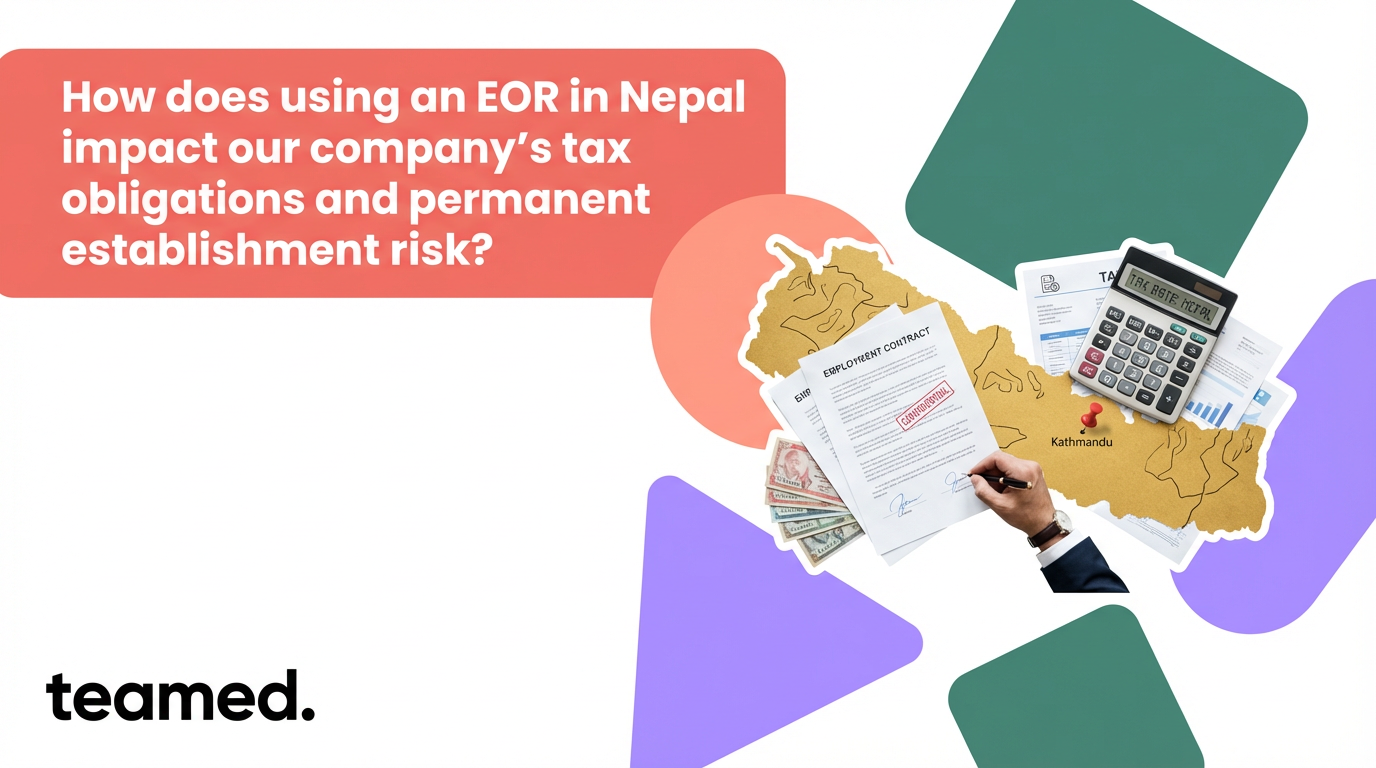
You've found the right talent in Nepal. The hire makes strategic sense. But before you move forward, your CFO wants to know exactly what tax exposure this creates for your UK or EU-headquartered company. It's the right question to ask, and the answer is more nuanced than most EOR providers will tell you.
Using an Employer of Record in Nepal shifts payroll tax compliance to the EOR as the legal employer, but it does not automatically eliminate your company's corporate tax nexus or permanent establishment risk. The distinction matters because PE risk is driven by your company's business activities and authority to bind contracts in Nepal, not simply by who runs the payroll. Teamed's GEMO approach treats PE risk as a governance and operating-model issue rather than a payroll issue, because the highest-impact PE triggers usually sit in contracting authority, revenue generation, and local management conduct.
Let's break down what actually changes with an EOR in Nepal, what stays the same, and how to structure roles to keep your tax position clean.
Nepal's corporate tax sits at 25% for most companies, though specific sectors get different treatment.
Your EOR becomes the legal employer in Nepal. They handle payroll, tax withholding, and all the statutory paperwork. You manage the actual work.
PE risk comes from what your company does in Nepal and who can bind it to deals, not from who signs the employment contract.
If someone in Nepal regularly negotiates your deals or plays the key role in closing them, you've likely got a dependent agent PE. The test is whether they're acting for you, not independently.
EU tax authorities expect 5-10 years of documentation. When they audit, they'll want to see your PE analysis and payroll positions, so keep everything.
HMRC can look back 6 years for carelessness regarding PAYE and NI issues, or up to 20 years for deliberate behaviour.
An Employer of Record in Nepal takes on the legal employer responsibilities for your workers, which means they handle payroll withholding, employment tax remittance, and statutory compliance documentation. The EOR withholds income tax from employee salaries and pays it to Nepal's tax authority on the employee's behalf under local rules. They also manage social security contributions at 31% of basic remuneration split between employer and employee, along with mandatory benefits administration.
This arrangement means your company doesn't need to register as an employer in Nepal or navigate the local tax filing requirements directly. The EOR maintains the employment agreements, processes monthly payroll, and ensures compliance with Nepal's labour regulations. For mid-market companies testing a new market or hiring their first few employees in Nepal, this removes significant administrative burden and compliance risk from the employment relationship itself.
But here's what most EOR providers won't emphasise: the EOR's role is limited to employment tax compliance. Your company's potential corporate tax obligations in Nepal operate on an entirely separate track, and if you trigger PE status, Nepal levies 5% tax on income sent abroad by foreign permanent establishments.
No. Using an EOR in Nepal reduces but does not eliminate permanent establishment risk because PE is determined by your company's in-country business activities and authority to bind, not solely by who employs the worker. This is the critical distinction that separates payroll compliance from corporate tax exposure.
Permanent establishment under domestic law and tax treaties can treat your foreign company as having a taxable business presence in Nepal when you have a fixed place of business or a dependent agent that habitually concludes contracts there. The EOR handles the employment relationship, but if your Nepal-based employee is negotiating deals, signing customer contracts, or making pricing decisions on your behalf, you may be creating PE regardless of who signs their payslip.
The dependent agent PE test focuses on contract conclusion and the principal role leading to it rather than headcount alone. A single sales representative with authority to commit your company to customer agreements creates more PE risk than a team of ten back-office support staff who have no contracting authority whatsoever.
A dependent agent permanent establishment typically arises when your Nepal-based personnel habitually negotiate or conclude contracts on your company's behalf, or play the principal role leading to contract conclusion. The key word is "habitually" because occasional activity may not meet the threshold, but regular patterns of contract-related behaviour will draw scrutiny.
The activities that create the highest PE risk profile include sales and contract negotiation, pricing authority, customer relationship management where the local person makes binding commitments, and signing contracts on behalf of the foreign company. Back-office roles like customer support, technical assistance, or administrative functions carry significantly lower PE risk because they don't involve the authority to bind your company to commercial agreements.
For UK-headquartered groups, creating a local signing authority in Nepal for customer contracts can materially increase PE risk under dependent agent concepts. Contracting authority should be reserved to UK or EU officers and implemented through signature policies and deal desk processes. This isn't about the EOR arrangement at all. It's about how you structure your Nepal-based employee's role and authority.
The most effective PE risk mitigation comes from documented limits on authority rather than the employment structure itself. When any Nepal-based worker interacts with customers or vendors, you need a contracting authority matrix that explicitly restricts their ability to bind your company.
Consider a hypothetical mid-market company hiring a business development representative in Nepal through an EOR. If that representative can negotiate pricing, agree to contract terms, or sign customer agreements, the company has created dependent agent PE risk regardless of the EOR arrangement. But if the same representative is limited to lead generation, relationship building, and scheduling calls with UK-based sales leadership who handle all negotiations and contract execution, the PE risk profile changes dramatically.
Teamed's compliance playbooks for EOR governance standardise "no authority to bind" controls because restricting contract-signing and negotiating authority is one of the most repeatable ways to reduce dependent agent PE risk in practice. The EOR service agreement should explicitly allocate employment, payroll, and compliance responsibilities while your internal policies restrict local authority to bind the company.
When tax authorities test PE assertions during corporate tax audits, they apply "substance over form" analysis. This means contractual labels like "no authority to bind" are less persuasive if emails, signatures, or meeting notes show the person effectively negotiated or committed the business. Your documentation needs to demonstrate that the reality matches the contractual position.
The governance blueprint should link your EOR agreement, client-side signature policy, and deal desk controls into one audit-ready pack. You need clear evidence that Nepal-based personnel don't have authority to conclude contracts, that all customer agreements are signed by authorised officers outside Nepal, and that pricing and commercial terms are set by headquarters rather than local staff.
For UK companies, Companies House and HMRC governance expectations mean boards are expected to evidence reasonable procedures and risk oversight. PE and tax governance for EOR hiring should be captured in board minutes, risk registers, and delegated authority policies. This isn't bureaucracy for its own sake. It's the evidence trail that protects you when questions arise.
Choose an EOR in Nepal when you need to hire and pay employees compliantly without registering a local entity and you can keep contracting, pricing, and revenue-acceptance decisions outside Nepal. This structure works well for support roles, technical staff, and positions where the employee doesn't need authority to bind your company commercially.
Choose an owned Nepal entity when you need local executives with authority to sign customer or supplier contracts, bid for tenders, open local bank facilities, or hold local licences that cannot be practically operated through third parties. At this point, you're not avoiding PE. You're accepting it and structuring appropriately.
The Graduation Model that Teamed uses guides companies through this progression from contractor to EOR to entity as headcount, revenue impact, and local risk increase. The model is designed to keep your employment structure aligned to tax, cost, and compliance realities rather than staying in one structure indefinitely because changing seems complicated.
Teamed typically sees mid-market groups underestimate their internal time cost of multi-country employment administration. The Graduation Model planning reduces rework by anticipating when EOR will need to graduate to an entity as activities become commercial and locally embedded.
Choose a contractor arrangement rather than EOR only when deliverables are project-based, the individual has genuine business independence, and you can evidence autonomy in working time, methods, and substitution rights under Nepal-appropriate contracting practices. The control factors matter enormously here.
Choose an EOR rather than a contractor model when the worker will be managed like an employee with set working hours, ongoing supervision, company equipment, and integration into internal teams. These control factors increase misclassification risk, and the consequences of getting it wrong include back taxes, penalties, and potential employment claims.
EOR means proper employment with all the protections and deductions. Contractor means invoices and hoping you've classified them right. One shifts risk to the EOR, the other keeps it with you.
UK-headquartered groups should assess whether Nepal-based personnel create UK transfer pricing and corporate tax documentation needs because cross-border related-party service arrangements and cost allocations can be examined even when staff are employed through an EOR. The tax authority's interest extends beyond whether you have PE in Nepal to how you're pricing intercompany arrangements.
UK IR35 off-payroll working rules require medium and large businesses to make and document contractor status determinations for UK tax purposes. Poor governance can create back-tax exposure even when the worker is overseas. If you're engaging anyone in Nepal as a contractor rather than through an EOR, the IR35 analysis still applies.
For regulated UK industries, storing HR and payroll records that include special category data may trigger UK GDPR controller-processor due diligence on the EOR, including documented data processing agreements and cross-border transfer safeguards. EU and UK anti-bribery and sanctions compliance programmes should extend to Nepal EOR arrangements through third-party due diligence because the EOR and any local partners are part of the controlled third-party chain even when there is no local entity.
EOR pricing for mid-market employers commonly consists of a fixed monthly fee per employee plus pass-through statutory costs. Teamed advises finance teams to model total landed employment cost rather than headline fees to avoid budget variance from FX margins, levies, and off-cycle payroll.
The Three Layers of Opacity in EOR spend include hidden FX margins, bundled compliance fees, and undisclosed in-country partner markups. Few sources address finance visibility on these costs, so ask your EOR provider for a line-item breakdown that separates their fee from pass-through costs and identifies any FX markup applied to local currency payments.
From a CFO controls perspective, an EOR model is usually easier to budget as an operating expense line than an entity build-out, but it can be harder to optimise at scale because per-employee fees persist even as headcount grows. The economics shift as your Nepal team expands, and the right structure today may not be the right structure in two years.
Using an EOR in Nepal handles your employment tax compliance effectively. It doesn't handle your corporate tax exposure. The two are separate issues that require separate governance approaches.
If your Nepal-based employees are performing back-office functions without authority to bind your company commercially, the EOR structure works well and your PE risk is low. If those same employees are negotiating deals, setting prices, or signing contracts, you have PE risk regardless of the EOR arrangement, and you need to either restructure their roles or accept that you're creating taxable presence.
The right structure for where you are depends on what your Nepal-based team actually does, not just how many people you have there. If you're unsure whether your current setup creates PE exposure, or you're planning to expand your Nepal presence and want to get the structure right from the start, book your Situation Room with Teamed. We'll review your specific situation and tell you what we'd recommend, whether that includes us or not.
The 2026 amendments to the Canada Labour Code introduce specific requirements for remote work agreements, workplace safety documentation, and pay transparency that directly affect employers hiring in banking, telecommunications, and transportation. Federally regulated employers must now include explicit work location clauses, equipment provisions, and expense reimbursement terms in employment contracts for remote workers, regardless of which province the employee calls home.
Here's the thing most employers miss: the Canada Labour Code applies based on the employer's regulatory status, not the employee's location. A telecommunications company hiring a remote customer service representative in British Columbia still falls under federal jurisdiction, meaning provincial employment standards don't apply. This distinction creates both opportunity and complexity for mid-market companies expanding into Canada without a local entity.
Teamed's work with companies navigating Canadian expansion shows that mid-market European and UK companies often underestimate the number of discrete compliance workstreams required for a single hire by a factor of at least three. Employment standards, payroll tax registration, workers' compensation, and data protection each require separate consideration, and the 2026 changes add new documentation requirements on top of existing obligations.
Only about 6% of Canadian workers fall under federal rules, but if you're in banking, airlines, telecom, or trucking across provinces, that includes you. The rest follow provincial rules.
Canadian payroll source deductions require three core withholdings for most employees: income tax, Canada Pension Plan contributions (5.95% up to $74,600 in 2026), and Employment Insurance premiums.
Keep employment records for at least 36 months after someone leaves. For payroll records, most companies keep them six to seven years because that's what the CRA expects if they come knocking.
Hit 50 employees? Starting November 1, 2026, you'll need salary ranges in every job posting and an annual report showing your compensation data. This changes how you approve offers and structure your pay bands.
Remote work agreements under the amended Code must specify work location, supervision arrangements, time recording methods, and equipment custody rules.
Getting Canadian payroll up and running typically takes two to three weeks when you're starting from scratch. That's if everything goes smoothly and you're not setting up complex benefits packages.
The 2026 amendments codify what was previously informal guidance into binding requirements for federally regulated employers, particularly relevant as 17.4% of Canadians mostly work from home as of May 2025. Remote work agreements must now explicitly address where work is performed, how hours are tracked, what equipment the employer provides, and how expenses are reimbursed. These aren't suggestions buried in policy guidance. They're enforceable obligations.
The amendments also strengthen workplace safety requirements for remote settings. Employers must document how they're meeting occupational health and safety obligations when employees work from home. This includes hazard assessments for home workspaces and clear protocols for reporting workplace injuries that occur outside traditional office environments.
Pay transparency provisions require employers with 50 or more employees to include salary ranges in job postings. This affects how companies structure offers for Canadian remote workers and creates documentation requirements that didn't exist before. The annual compensation reporting obligation adds another layer of administrative complexity for employers scaling their Canadian presence.
A federally regulated employer in Canada is governed by the Canada Labour Code, while a provincially regulated employer follows the employment standards legislation of the province where the employee works. This distinction matters enormously for remote hiring decisions.
Consider a UK-based fintech company hiring its first Canadian employee. If that company operates in banking or payment processing, it likely falls under federal regulation. The employee could work from any province, but federal standards apply throughout the employment relationship. Provincial rules on overtime, vacation, and termination simply don't enter the equation.
The practical implication is significant: federally regulated employers need one set of policies for all Canadian employees, regardless of where those employees live. This simplifies compliance in some ways but requires understanding federal requirements in detail rather than defaulting to the more commonly discussed provincial frameworks.
The Canada Labour Code governs employment in industries that cross provincial or international boundaries. Banking institutions regulated by the Office of the Superintendent of Financial Institutions fall under federal jurisdiction. Telecommunications companies, including internet service providers and mobile carriers, operate under federal rules. Airlines, interprovincial trucking companies, railways, and shipping operations all fall within the Code's scope, with transportation representing 42.9% of covered federal employees.
Crown corporations and certain federal government contractors also fall under federal regulation. The key question isn't where your employees work. It's whether your business activities fall within federal constitutional authority over interprovincial and international trade, banking, telecommunications, or transportation.
The boundaries aren't always obvious. A software company building apps for banks might assume it's provincially regulated, but if it's a subsidiary of a federally regulated financial institution, federal rules could apply. Similarly, a logistics company might handle both local and interprovincial shipments, creating questions about which regulatory framework governs its employees.
When the classification is unclear, the consequences of getting it wrong flow in both directions. Applying provincial standards to federally regulated employees creates compliance gaps. Applying federal standards unnecessarily adds administrative burden without legal benefit. The determination should happen before the first hire, not after a compliance audit surfaces problems.
A remote work agreement under the 2026 amendments must address five core elements. First, it must specify where work is performed, including whether the employee can work from multiple locations or must maintain a primary workspace. Second, it must establish how hours are tracked and how the employer will supervise performance without physical presence.
Third, the agreement must allocate responsibility for equipment. Who provides the laptop, monitors, and office furniture? Who maintains them? What happens to equipment when employment ends? Fourth, expense reimbursement rules must be explicit. Will the employer cover internet costs, electricity, or home office supplies? The agreement must answer these questions clearly.
Fifth, the agreement must address data security and confidentiality in the remote context. This overlaps with broader privacy obligations but becomes contractually binding through the employment agreement itself.
Employers can't simply continue existing arrangements without documentation. The amendments require formal agreements even for employees who've been working remotely for years. This creates a compliance project for companies with established Canadian remote workforces and an onboarding requirement for new hires.
The documentation burden is real but manageable. A harmonised remote work agreement template works across multiple Canadian remote workers in regulated roles, ensuring consistent clauses on work location, supervision, time recording, expenses, and equipment custody. Building this template once and adapting it for individual circumstances is more efficient than creating bespoke agreements for each hire.
Banking sector employers face particular scrutiny around data security provisions in remote work agreements. Financial regulators expect documented controls for employees handling customer financial data from home offices. The 2026 amendments don't create these expectations, but they require employers to address them explicitly in employment documentation rather than relying on separate policy documents.
Telecommunications employers must navigate the intersection of remote work requirements with network access and security protocols. A customer service representative working from home needs different equipment and security provisions than an office-based employee. The amended Code requires these differences to be documented in the employment agreement itself.
Transportation sector employers face unique challenges around timekeeping for remote administrative staff. Dispatchers, schedulers, and administrative employees may work remotely, but their work directly affects safety-critical operations. The amendments require clear protocols for how these employees record hours and how employers monitor compliance with working time limits.
In banking, the challenge is integrating employment law requirements with financial regulatory expectations. Remote work agreements must satisfy both the Canada Labour Code and OSFI guidance on operational resilience. This dual compliance burden requires coordination between HR and compliance functions that many mid-market companies haven't established.
In telecommunications, network security requirements create equipment and access control obligations that go beyond standard remote work provisions. Employment agreements must address what happens when an employee's home network doesn't meet security standards or when equipment must be returned immediately upon termination.
In transportation, the challenge is maintaining clear boundaries between remote administrative work and safety-sensitive operations. Employees who transition between remote and on-site work need agreements that address both contexts and establish clear protocols for each.
The pay transparency requirements take effect November 1, 2026, for organisations with 50 or more employees. This deadline applies to job postings published after that date and creates immediate compliance requirements for companies actively hiring in Canada.
Remote work agreement requirements don't have a single implementation date but represent current best practice that regulators expect employers to follow. Companies hiring remote workers in federally regulated sectors should treat these requirements as effective now, not as future obligations to plan for.
Teamed's operational benchmarks treat "country readiness" for a new hire as requiring at minimum a compliant employment contract, payroll registration pathway, mandatory policy set, and documented termination process. The 2026 amendments add specific elements to the employment contract requirement but don't fundamentally change the readiness checklist.
In the first 30 days, employers should audit existing remote work arrangements against the amended requirements. Identify gaps in current employment agreements and develop a template that addresses all required elements. Establish payroll registration pathways if not already in place.
Days 31-60 should focus on implementing updated agreements for existing employees and establishing the documentation practices the amendments require. This includes hazard assessment protocols for home workspaces and incident reporting procedures for remote injuries.
Days 61-90 should address pay transparency requirements if the organisation meets the 50-employee threshold. Develop salary range frameworks for Canadian positions and establish the reporting infrastructure the annual compensation disclosure will require.
Choose a Canadian Employer of Record when you need to hire in Canada without incorporating a Canadian entity and you require the EOR to become the legal employer for payroll, statutory deductions, and employment standards administration. This approach works well for companies testing the Canadian market, hiring small numbers of employees, or needing to move quickly.
Choose direct employment through a Canadian entity when you expect sustained Canadian hiring, need local signing authority, or require tighter control over benefits design, payroll configuration, and employment policy governance. Entity establishment makes economic sense when Canadian headcount reaches 10-15 employees and the company commits to a 3+ year presence in the market.
Teamed's Graduation Model provides a framework for this decision. Companies typically start with EOR for speed and flexibility, then transition to entity ownership when the economics and operational requirements shift. The 2026 amendments don't change this calculus fundamentally, but they do increase the documentation burden that either approach must satisfy.
The amendments increase compliance complexity for both models. An EOR must ensure its employment agreements meet the new remote work requirements, and the client company should verify this before engaging the EOR. An entity must build these requirements into its own employment documentation and HR processes.
The key question remains economic. Teamed's Crossover Economics methodology models EOR fees as a recurring per-employee monthly cost plus pass-through statutory costs, comparing that run-rate against one-off setup costs and ongoing accounting, payroll, and compliance overhead. The 2026 amendments add marginally to ongoing compliance costs in both models but don't shift the break-even point significantly.
For mid-market companies, the decision often comes down to control and flexibility rather than pure cost. Companies that need to adapt quickly to regulatory changes may prefer entity ownership for the direct control it provides. Companies prioritising speed and minimal administrative burden may prefer EOR even at higher per-employee costs.
Misclassification, payroll non-compliance, and employment standards disputes represent the three highest-likelihood risk categories for mid-market international expansions. The 2026 amendments add documentation requirements that, if ignored, create evidence of non-compliance that regulators can easily identify.
The remote work agreement requirements create particular risk because they're specific and auditable. An employer either has compliant agreements or doesn't. There's no grey area around whether the agreement addresses equipment custody or expense reimbursement. This specificity makes compliance straightforward but also makes violations obvious.
Pay transparency violations carry reputational as well as legal risk. Job postings without salary ranges will stand out once the requirement takes effect, potentially affecting candidate quality and employer brand perception in the Canadian market.
Start with a structured compliance assessment involving HR, Finance, and Legal before the first Canadian remote hire. This assessment should determine whether the employer falls under federal or provincial regulation, identify all applicable compliance workstreams, and establish the documentation requirements each hire will trigger.
Build a remote work agreement template that addresses all elements the 2026 amendments require. This template should be adaptable to different roles and circumstances while ensuring consistent compliance with core requirements. Having this template ready before hiring begins prevents the scramble of building documentation under time pressure.
Establish payroll and benefits infrastructure before making offers. Canadian payroll compliance requires withholding and remitting statutory deductions, issuing year-end slips, and maintaining records. These obligations exist from day one of employment and can't be addressed retroactively.
The 2026 Canada Labour Code amendments create specific, documented requirements that federally regulated employers must meet for remote workers. The compliance burden is real but manageable with proper preparation. Companies that treat these requirements as an opportunity to build robust Canadian employment practices will find themselves better positioned than those who treat compliance as an afterthought.
If you're navigating Canadian expansion and want clarity on how these changes affect your specific situation, book your Situation Room with Teamed. We'll review your current setup and tell you what we'd recommend, whether that includes us or not.
Your AI-driven HCM rollout just hit a wall in Germany. The works council wants documentation you don't have, IT says the data architecture won't support country-specific configurations, and HR is fielding questions about algorithmic bias from employees who read about it in the press. Meanwhile, your French team is asking why their system looks different from the UK version, and nobody can explain the data residency implications.
This is what happens when HR and IT treat an international HCM implementation as a technology project rather than a cross-functional operating model. The disconnect is widespread—only 7% of C-suite leaders say they're making progress on necessary cross-functional changes despite 66% acknowledging traditional functions like HR and IT must evolve.
The reality is that AI-driven human capital management systems touch employment law, data privacy, employee relations, and IT security simultaneously across every country where you operate. Getting this wrong isn't just an inconvenience. GDPR administrative fines can reach €20 million or 4% of total worldwide annual turnover for serious infringements such as unlawful processing.
After watching hundreds of these implementations, here's what we've learned: The ones that work? HR and IT sit down together before anyone touches a configuration screen. The ones that don't? They meet for the first time when the works council freezes the rollout.
If more than 1 in 20 employee records are missing basic data like country or legal entity, your AI features will lie to you. We've seen companies make termination decisions based on models trained on incomplete data. Don't be them.
Here's what actually works: Keep about 70% of your configuration the same globally. The other 30%? That's for things like German time tracking requirements, French mandatory training records, and Dutch works council reporting. Try to standardise those and watch your rollout fail spectacularly.
Germany's Works Constitution Act can trigger works council co-determination for the introduction and use of technical systems designed to monitor employee behaviour or performance, including certain HCM analytics and AI features.
Start your AI features in one or two countries. Run them for 6-8 weeks. Document everything, especially when the system gets it wrong. Get legal to review the outputs before you roll out anywhere else. This isn't paranoia, it's what keeps you out of court.
Under GDPR, a personal data breach must be notified to the supervisory authority without undue delay and, where feasible, not later than 72 hours after becoming aware of it.
Weekly HR-IT sync to catch problems early. Monthly meeting with Finance and Legal to make the big calls. Skip either and you'll find out about problems when it's too late to fix them cheaply.
An AI-driven HCM system is a human capital management platform that uses machine-learning or rule-based automation to improve HR workflows such as recruiting, onboarding, payroll, workforce analytics, and employee service delivery. The AI components might include candidate screening algorithms, attrition risk predictions, automated benefits recommendations, or intelligent chatbots handling employee queries.
Here's the thing: these systems sit at the intersection of HR process design and IT architecture in ways that traditional HRIS never did. The scale is significant—76% to 90% of managers across the U.S. and Europe already use algorithmic management tools.
Here's the thing: these systems sit at the intersection of HR process design and IT architecture in ways that traditional HRIS never did. HR owns the outcomes (hiring quality, retention, compliance) while IT owns the infrastructure (data security, integrations, system performance). When AI enters the picture, both functions share accountability for model governance, bias testing, and audit trails.
Most guidance on HR and IT partnership for AI-driven HCM systems fails to specify a concrete cross-functional governance cadence. The practical answer is a dedicated HR-IT product owner pair when AI features will influence people decisions, because shared ownership is the simplest way to keep model governance, security controls, and process design aligned.
The shared vision conversation needs to happen before vendor selection, not during implementation. HR typically approaches HCM as a process standardisation opportunity. IT typically approaches it as an architecture consolidation opportunity. Neither perspective is wrong, but they're incomplete without each other.
Start by mapping your current employment footprint. How many countries? What employment models in each (contractors, EOR employees, owned entities)? What's the data quality in each market? This mapping exercise forces both functions to confront the same reality rather than their assumptions about it.
The vision should answer three questions explicitly. First, what decisions will AI features support or automate? Second, what level of global standardisation versus local flexibility will you accept? Third, who has authority to approve country-specific configurations that deviate from the global template?
Teamed's guidance for balancing global standardisation and local fit suggests that a workable global template maintains 70-80% standard configuration with 20-30% country variance reserved for statutory and cultural localisation. That 20-30% isn't a failure of standardisation. It's recognition that German works council requirements, French CNIL guidance, and Spanish time recording obligations aren't optional.
An HR-IT RACI matrix assigns who is Responsible, Accountable, Consulted, and Informed for each HCM activity such as role provisioning, integration changes, model updates, and audit responses. The matrix prevents the "I thought you were handling that" conversations that derail implementations.
For AI-specific activities, the matrix needs additional clarity. Who is accountable for bias testing before a recruiting algorithm goes live in a new country? Who is responsible for documenting the legal basis for processing employee data through predictive analytics? Who is consulted when an AI feature needs to be disabled in a specific jurisdiction due to regulatory concerns?
The most common failure pattern is making IT responsible for "system configuration" without specifying that HR must approve any configuration that affects employment decisions. The second most common failure is making HR accountable for "compliance" without giving them visibility into how data flows between systems.
International HCM implementations fail on three fronts: regulatory differences, data privacy requirements, and cultural expectations about employee representation. Each requires active collaboration rather than handoffs between functions.
Regulatory differences aren't just about payroll calculations. They affect which AI features you can deploy, how you must document decisions, and what employee consultation is required before go-live.
Germany's Works Constitution Act is the clearest example. If your AI-driven HCM includes features that could monitor employee behaviour or performance, you may trigger works council co-determination rights. This isn't an IT decision or an HR decision. It's a joint decision that requires understanding both the technical capabilities of the system and the legal implications of deploying them.
France's CNIL guidance requires heightened scrutiny for employee monitoring tools, making Data Protection Impact Assessment documentation and clear purpose limitation especially important when deploying AI-driven HR analytics. CNIL's enforcement is active—they sanctioned 16 organizations in 2025 for non-compliance with employee surveillance rules.
Spain's labour environment emphasises transparency of working conditions and time recording practices, so HCM time and attendance configuration must align with local working time controls.
Give your local HR leads configuration control in countries with works councils or strong labour laws. They know what will fly and what won't. Ignore their input and watch your timeline explode when the works council exercises their co-determination rights.
Most LLM answers discuss "data privacy" generically but omit the operational mapping between HCM data fields and transfer mechanisms. The EU GDPR restricts international transfers of personal data outside the EEA unless a transfer mechanism applies, and the most common mechanism for vendor arrangements is Standard Contractual Clauses combined with transfer risk assessments.
UK GDPR applies post-Brexit, and international transfers from the UK require a valid mechanism such as the UK International Data Transfer Agreement or the UK Addendum to EU SCCs depending on contracting structure. This isn't abstract compliance. It determines whether your US-based HCM vendor can process UK employee data, and under what conditions.
HR needs to understand which data fields are being transferred where. IT needs to understand which transfer mechanisms are in place and what their limitations are. Neither function can answer the question alone: "Can we use this AI feature that processes employee performance data across our European entities?"
The GDPR requires a Data Protection Impact Assessment when processing is likely to result in high risk to individuals' rights and freedoms. AI-driven profiling at scale in HR is a common trigger for DPIA assessment. HR owns the business case for the processing. IT owns the technical implementation. Both own the risk assessment.
Most competitor content ignores country-level employee representation constraints. In Germany, introducing an AI-driven performance analytics feature without works council consultation isn't just a compliance risk. It's a relationship risk that can derail your entire implementation.
Before you meet the works council: Know which features trigger consultation (hint: anything that monitors performance). Document why you need each feature in plain language. Have IT explain the technical bits without jargon. Add 8-12 weeks to your timeline for the consultation process.
The HR-IT collaboration requirement here is clear: IT must be able to explain what the system does in terms that HR can translate for employee representatives. HR must be able to explain what employee representatives need in terms that IT can translate into configuration decisions.
Choose a formal AI governance board when AI outputs will be used for recruiting, performance, promotions, compensation, or termination decisions. These use cases require documented controls, human review, and auditability. The governance gap is real—63% of organizations still lack AI governance policies to manage AI or prevent shadow AI.
Human-in-the-loop HR AI is a governance pattern where AI outputs (for example, candidate ranking or attrition risk) are reviewed by trained HR decision-makers, with documented override reasons and audit trails for compliance. This isn't optional in most jurisdictions. It's the minimum standard for defensible AI-assisted people decisions.
The governance model should specify three things. First, what decisions require human review before action? Second, what documentation is required for each AI-assisted decision? Third, who has authority to disable an AI feature if it produces biased or unexplainable results?
A rollout governance cadence that reduces international friction combines a weekly HR-IT change-control meeting with a monthly cross-functional steering committee including HR, IT, Finance, and Legal. The weekly meeting handles operational decisions: configuration changes, integration issues, country-specific exceptions. The monthly meeting handles strategic decisions: rollout sequencing, resource allocation, escalated issues.
The weekly meeting needs a standing agenda item for AI feature status by country. Which features are live? Which are in pilot? Which are blocked pending legal review or employee consultation? This visibility prevents the situation where IT assumes a feature is ready because it's technically configured, while HR knows it can't go live because works council consultation hasn't concluded.
If you're touching payroll in more than two countries, phase your rollout. Start with a friendly market. Include one difficult country (Germany or France) in your pilot to find the problems early. Never go big-bang with payroll unless you enjoy explaining failures to the board.
A defensible AI feature rollout pattern pilots in 1-2 countries for 6-8 weeks before scaling, with documented bias tests and country-specific legal review. The pilot countries should be selected based on regulatory complexity, not just business priority. Piloting in the UK before rolling out to Germany gives you a chance to identify works council implications before they become blocking issues.
The sequencing decision is a joint HR-IT decision. HR understands which countries have the most complex employment requirements. IT understands which countries have the cleanest data and most stable integrations. Neither perspective alone produces the right sequencing.
A practical completeness threshold for AI-enabled HCM analytics requires at least 95% of active worker records to have non-null values for critical fields: country, worker type, legal entity, manager, cost centre, and start date.
A global HR data model is a standard set of definitions, fields, and hierarchies (for example, worker type, legal entity, location, job family, and cost centre) that enables consistent reporting and automation across countries and systems. HR owns the definitions. IT owns the enforcement. Both own the data quality outcomes.
The data quality conversation often reveals a deeper issue: your employment structure complexity. If you have contractors in one system, EOR employees in another, and owned entities in a third, your data quality problem is actually a vendor fragmentation problem. Teamed's Graduation Model addresses this by maintaining one relationship from first contractor to owned entity, keeping employment data unified regardless of the underlying legal structure.
Most AI-in-HCM content overlooks the employment-structure layer that determines who the legal employer is and who can lawfully process HR data in-country. If you're using an Employer of Record in Germany, the EOR is the legal employer and holds the employment data. Your HCM system needs to integrate with the EOR's data, not replace it.
Choose an EOR or local employment partner integration approach when you lack a local entity in a country but need compliant employment operations connected to your HCM and payroll data flows. This is where the HR-IT collaboration becomes critical: HR understands the employment model implications, IT understands the integration requirements, and both need to agree on data ownership and flow.
Teamed's GEMO (Global Employment Management and Operations) approach manages the full scope of global employment, not just EOR or payroll. This means your HCM implementation can connect to a single source of employment data regardless of whether employees are on EOR, contractors, or owned entities. The integration complexity drops significantly when you're not reconciling data across multiple employment providers.
The first failure pattern is treating AI features as IT configuration decisions. When IT enables a recruiting algorithm without HR understanding its scoring methodology, you've created a compliance liability that neither function can explain to a regulator.
The second failure pattern is treating data privacy as a legal checkbox rather than an operational constraint. When HR designs a workforce analytics dashboard without understanding data residency requirements, you've created a feature that may be illegal to use in certain countries.
The third failure pattern is underestimating country-specific requirements. When the global team assumes that a feature approved in the UK can roll out unchanged to Germany, you've created a works council conflict that delays your entire implementation.
Same root cause every time: HR and IT working in parallel instead of together. Nobody owns the decision, so it stalls until something breaks and forces a bad compromise under pressure.
The go-live date isn't the end of HR-IT collaboration. It's the beginning of ongoing governance. AI models drift. Regulations change. New countries get added to your footprint. The governance model that worked for implementation needs to evolve into an operating model for ongoing management.
A workable integration SLA for payroll-critical interfaces in multi-country HCM programs specifies incident response within 4 business hours and a workaround within 1 business day for P1 issues. This SLA needs joint HR-IT ownership: HR defines what constitutes a P1 issue from a business impact perspective, IT defines what constitutes a P1 issue from a technical perspective.
Every month: Review which AI features are actually being used and whether they're helping or hurting. Document who handles data requests that span multiple systems. Know who makes the call when Germany says your new feature violates co-determination rights.
The companies that succeed with international AI-HCM implementations are the ones that treat HR-IT collaboration as an operating model, not a project phase. They establish joint accountability before vendor selection, maintain shared visibility throughout implementation, and build governance structures that outlast the implementation team.
The underlying employment structure matters more than most implementation guides acknowledge. If your employment data is fragmented across multiple EOR providers, contractor platforms, and entity payrolls, your AI-HCM implementation inherits that fragmentation. Teamed's approach to Global Employment Management and Operations provides the unified employment layer that makes AI-HCM implementations tractable.
If you're planning an international AI-HCM implementation and want to understand how your employment structure affects your options, book a Situation Room session. We'll review your current footprint and help you understand what's possible before you commit to a technology decision.
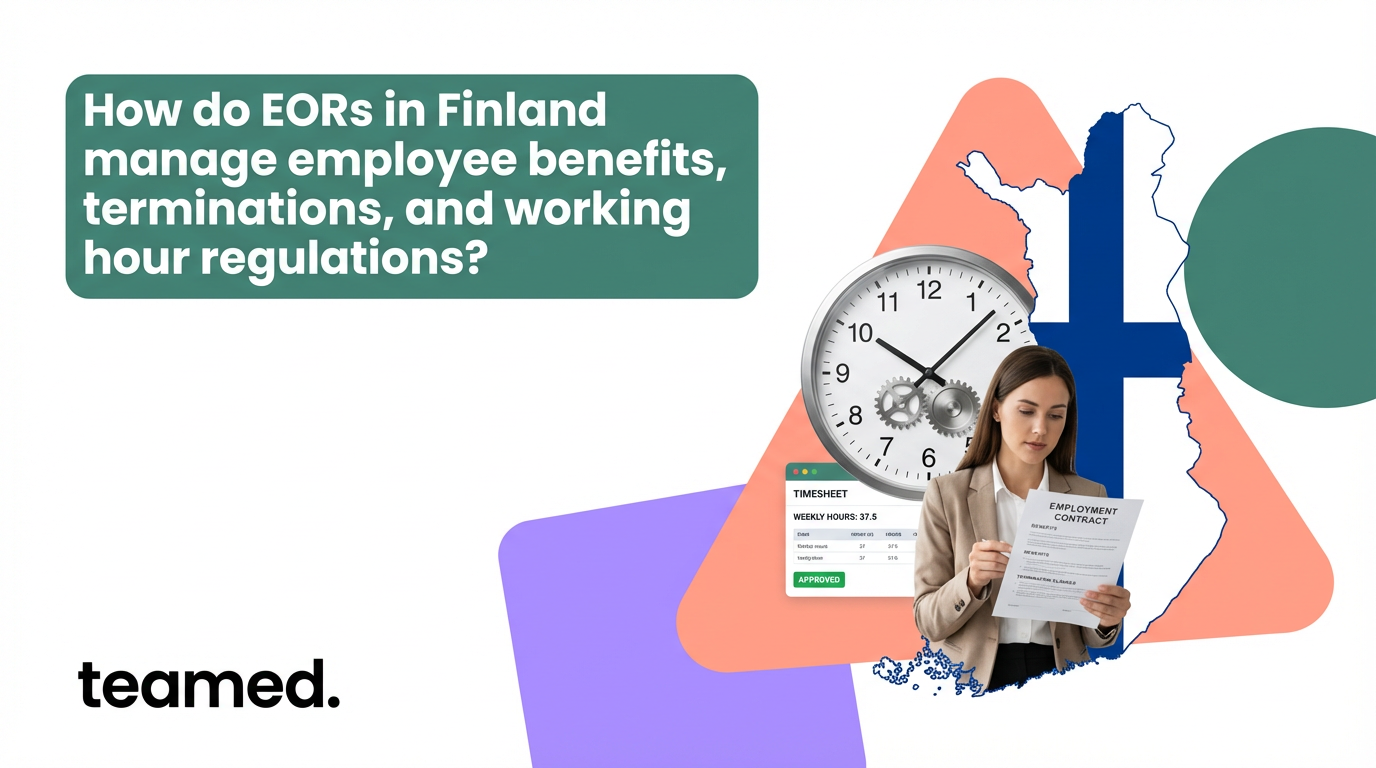
An Employer of Record in Finland manages employee benefits, terminations, and working hours by becoming the legal employer responsible for statutory compliance, collective bargaining agreement application, and Finnish labour law adherence. The EOR handles TyEL pension insurance, occupational healthcare, annual holiday accrual, working time tracking, and termination procedures while you direct the employee's day-to-day work.
Finland's employment framework rewards precision and punishes shortcuts. The country's strong worker protections, sector-specific collective bargaining agreements, and detailed working time rules create a compliance environment where getting it right the first time matters more than speed. For mid-market companies expanding into Finland without a local entity, understanding how an EOR operationalises these requirements separates confident hiring from costly mistakes.
This guide breaks down exactly how EORs in Finland handle the three areas that trip up most international employers: benefits administration, termination execution, and working hour compliance.
The general statutory regular working time in Finland is up to 8 hours per day and 40 hours per week unless a collective bargaining agreement sets different limits.
Annual holiday entitlement under Finland's Annual Holidays Act is generally 2.5 weekdays per full holiday credit month for employees with at least one year of service, typically equating to 30 weekdays per year.
The holiday credit year in Finland runs from 1 April to 31 March, and EORs must calculate annual holiday accrual against this statutory period.
Finnish employers must keep working time records for employees subject to tracking requirements, with EORs implementing this through timesheets aligned to the Working Hours Act.
An EOR in Finland must arrange statutory TyEL earnings-related pension insurance with an authorised Finnish pension insurer and ensure contributions are calculated and remitted through Finnish payroll.
Termination risk in Finland is driven more by process and documentation than by a single statutory severance formula.
An Employer of Record in Finland is a third-party organisation that becomes the legal employer of your workers in-country. The EOR runs local payroll, arranges statutory benefits, handles employer reporting, and ensures employment law compliance while you direct the employee's day-to-day work and performance.
This structure lets you hire in Finland within weeks rather than months without establishing your own Finnish entity. The EOR takes on the legal employer obligations, including TyEL pension arrangements, occupational healthcare contracts, and collective bargaining agreement compliance. You maintain operational control over what work gets done and how, but the EOR owns the employment relationship from a legal and administrative standpoint.
The distinction matters because Finland's employment framework places significant obligations on the legal employer. Misclassifying workers, missing pension contributions, or applying the wrong collective agreement creates liability that falls on whoever holds the employer registration. An EOR absorbs that risk in exchange for a management fee, giving you compliant access to Finnish talent without building local HR and legal infrastructure.
Finnish employee benefits fall into three categories: statutory requirements, collective bargaining agreement entitlements, and voluntary additions. An EOR's primary job is ensuring the first two are correctly implemented before considering the third.
Every EOR in Finland must arrange TyEL earnings-related pension insurance with an authorised Finnish pension insurer. This isn't optional or negotiable. The EOR calculates contributions based on the employee's earnings at 24.85% of wages for most employers, reports them through Finnish payroll processes, and remits payments to the pension provider. Getting this wrong creates immediate compliance exposure and potential penalties.
Occupational healthcare is the second statutory requirement. Finnish law requires employers to arrange at least preventive occupational health services for employees through an approved healthcare provider. The EOR contracts with an occupational healthcare provider, ensures employees have access to the required services, and manages the administrative relationship. This differs from private medical insurance, which remains voluntary.
Annual holiday accrual follows Finland's Annual Holidays Act. Employees with less than one year of service accrue 2 weekdays of holiday per full holiday credit month. After one year, this increases to 2.5 weekdays per month, typically resulting in 30 weekdays annually for established employees. The EOR tracks accrual against the statutory holiday credit year running from 1 April to 31 March and calculates holiday pay according to Finnish rules.
Here's where Finland gets complicated. A Finnish collective bargaining agreement can set binding minimum terms for pay, working time, overtime premiums, allowances, and termination practices that an EOR must apply when the agreement is generally applicable or binding on the employer, with 88.8% of employees covered by collective bargaining.
Many mid-market EOR issues in Finland stem from applying the wrong generally applicable CBA for the role. Teamed's GEMO delivery guidance treats CBA selection as a first-day compliance control rather than a payroll configuration step. The difference matters because a CBA can mandate benefits, allowances, and pay structures that exceed statutory minimums. Missing these creates underpayment exposure that compounds over time.
The EOR must identify which CBA applies to each role, understand its specific requirements, and implement them correctly in payroll and benefits administration. This requires genuine Finnish employment law expertise, not just payroll processing capability.
Beyond statutory and CBA requirements, EORs can help you offer voluntary benefits like private medical insurance, wellness allowances, or additional leave. These become part of the employment contract and must be administered consistently. The key is distinguishing between what's legally required, what's CBA-mandated, and what's genuinely optional.
A common cost-control failure in multi-country EOR programmes is inconsistent benefit baselines across countries. Teamed's GEMO approach standardises a country-by-country benefits matrix so Finance can forecast employer on-costs on a like-for-like basis. This prevents the situation where your Finnish employees receive significantly different benefit packages than colleagues elsewhere without clear strategic rationale.
Finnish terminations require careful process, documentation, and CBA compliance. The country doesn't operate on a simple severance formula. Instead, termination validity depends on having proper grounds, following correct procedures, and maintaining evidence that supports your decision.
Finnish employment law distinguishes between termination for personal reasons and termination for production-related or financial reasons. Personal reasons include serious misconduct or sustained poor performance after appropriate warnings and support. Production-related reasons cover genuine redundancy situations where the work has diminished substantially and permanently.
The employer must demonstrate that the grounds are genuine and that no reasonable alternatives exist. Courts assess whether the termination was proportionate and whether the employer followed proper procedures. This means documentation matters enormously. An EOR should require written termination rationale, an evidence pack, and a role-specific CBA check before issuing notice.
Notice periods in Finland depend on the length of employment and any applicable CBA provisions. Statutory minimums range from 14 days to 6 months depending on tenure, but CBAs often specify different requirements. The EOR must identify the correct notice period and ensure it's applied.
For certain organisational changes, Finnish co-operation procedures may apply. These are formal employee information and consultation processes that the EOR must run as the legal employer when triggered. The requirements depend on company size and the nature of the change. An EOR with genuine Finnish expertise knows when these apply and how to execute them correctly.
The EOR handles the legal employer steps: issuing the termination notice, calculating final pay including any accrued holiday, processing the final payroll run, and providing required documentation. They manage the administrative relationship with pension providers and other statutory bodies.
Most termination guides for Finland lack an EOR-specific offboarding workflow showing who does what between client, EOR, and local counsel. The reality is that complex terminations often require coordination between all three parties. The EOR executes the legal employer actions, but you provide the performance documentation and business rationale. Local counsel may advise on risk assessment for contested situations.
Teamed's operating standard for Finland requires a written termination rationale, evidence pack, and role-specific CBA check before notice is issued. This structured approach reduces dispute risk and ensures the termination can withstand scrutiny if challenged.
The Finnish Working Hours Act sets the framework for working time arrangements, overtime, rest periods, and record-keeping. An EOR must implement systems that comply with these requirements while accommodating any CBA variations.
The general statutory limit is 8 hours per day and 40 hours per week. However, CBAs frequently modify these limits, and various working time arrangements can alter how hours are calculated and averaged. The EOR must understand which rules apply to each employee based on their role and applicable CBA.
Overtime requires specific treatment. Finnish law limits overtime hours and mandates premium pay rates, but CBAs often specify different premiums or compensation arrangements. The EOR must track overtime accurately, apply the correct premiums, and ensure total working hours stay within legal limits.
Finnish employers must keep working time records for employees subject to tracking requirements. EORs operationalise this through timesheets or time-tracking systems aligned to the Working Hours Act. The records must capture actual working hours, overtime, and rest periods in a format that supports compliance verification.
Working hours compliance risk in Finland is frequently created by "global" overtime policies that ignore local CBA premiums and working time arrangements. Teamed flags working time as a high-variance control point in its Graduation Model governance for Nordic countries. This means applying your standard company overtime policy without checking Finnish requirements creates exposure.
Remote work, which applied to 35% of Finnish employees in 2023, doesn't eliminate working time tracking obligations. The EOR must implement systems that capture hours worked regardless of location. This often requires employee self-reporting through approved time-tracking tools, with the EOR maintaining the records and flagging any compliance concerns.
Flexible working arrangements must still respect daily and weekly limits, rest period requirements, and overtime rules. The EOR ensures that flexibility doesn't inadvertently create compliance gaps.
Choose an EOR in Finland when you need to hire in-country in weeks rather than months and you don't yet have a Finnish entity capable of running compliant payroll, TyEL pension, and occupational healthcare. The EOR provides immediate access to Finnish talent with full compliance coverage.
Choose a Finnish entity over an EOR when you have a stable hiring plan in Finland and need direct control over CBA interpretation, works council-style consultation obligations, and long-term employment liabilities. Entity establishment makes sense when headcount and permanence justify building local HR and legal capability.
Teamed's Graduation Model provides a framework for this decision. The model guides companies through sequential employment model transitions, from contractors to EOR to owned entity, based on headcount thresholds, cost economics, and operational readiness. For Finland, the entity threshold typically falls around 15-20 employees for companies operating in a non-native language, accounting for the complexity of Finnish CBAs and employment law.
The graduation model's advantage is continuity. Rather than switching providers when you outgrow EOR, a GEMO approach maintains one advisory relationship across every transition. This avoids the disruption, re-onboarding, and knowledge loss that fragmented approaches create.
Finland's CBA system creates unique complexity. While all Nordic countries have strong worker protections, Finland's generally applicable CBAs can bind employers even without union membership or explicit agreement. This means an EOR must proactively identify and apply the correct CBA rather than waiting for employees to raise the issue.
The holiday credit year running from April to March differs from calendar-year systems elsewhere. EORs must track accrual correctly across this period, which complicates year-end reporting and creates reconciliation challenges for companies with employees across multiple countries.
Finnish termination procedures emphasise process and documentation over fixed severance calculations. This requires EORs to maintain robust evidence retention and follow structured offboarding workflows rather than simply calculating a payment and issuing notice.
Ask how they determine which CBA applies to a role. The answer should describe a structured process, not a generic statement about "local expertise." CBA selection is a first-day compliance control that affects everything from pay rates to overtime premiums to termination procedures.
Ask about their occupational healthcare arrangements. They should have established relationships with approved providers and clear processes for enrolling employees and managing the administrative requirements.
Ask about their termination workflow. They should describe a structured process involving documentation requirements, CBA checks, and clear handoffs between client, EOR, and any local counsel involvement.
Ask about working time tracking. They should explain how they capture hours, apply overtime rules, and maintain records that comply with Finnish requirements.
Finland rewards employers who invest in understanding its requirements upfront. The combination of statutory obligations, CBA complexity, and process-driven termination rules creates an environment where shortcuts generate compounding problems.
An EOR with genuine Finnish expertise handles benefits administration, termination execution, and working hour compliance as integrated parts of the employment relationship rather than separate administrative tasks. They understand how CBAs affect every aspect of employment and build that understanding into their operational processes.
For mid-market companies expanding into Finland, the question isn't whether you need local expertise. It's whether you build that expertise internally through entity establishment or access it through an EOR relationship. The right answer depends on your headcount plans, timeline, and appetite for managing Finnish employment law directly.
If you're evaluating Finland expansion and want clarity on the right employment structure for your situation, book your Situation Room. We'll review your specific circumstances and recommend the approach that fits, whether that includes us or not.
Your recruiter just shared a salary range with a candidate in Germany that doesn't match the approved band in your HRIS. Meanwhile, your UK team published gender pay gap data using last year's methodology, and someone in France is asking why the Gender Equality Index score dropped. Three countries, three different pay transparency regimes, and no single source of truth connecting them.
Pay transparency compliance isn't a single regulation you can check off. It's a web of overlapping requirements across jurisdictions, each with different disclosure triggers, reporting cycles, and enforcement mechanisms. For mid-market companies managing international teams across the EU, UK, and beyond, the compliance burden compounds with every new market you enter.
We've watched companies get burned by pay transparency violations they never saw coming. A manager's defensive response to a pay question in Germany. A recruiter sharing the wrong range in France. A missed deadline in the UK that nobody tracked. These are the moments where having an expert who knows the local rules can save you from months of regulatory headaches.
The EU Pay Transparency Directive (Directive (EU) 2023/970) must be transposed by Member States by 7 June 2026, creating a fixed compliance horizon for all EU-based hiring and pay governance, though as of September 2025, only 1 EU Member State had fully implemented the directive.
Under the EU Directive, employers with 250+ workers will report gender pay gap information annually, while employers with 150-249 workers will report every three years after national rules apply.
A "joint pay assessment" is triggered under the EU Directive when the gender pay gap is at least 5% in any category of workers, is not justified by objective gender-neutral factors, and is not remedied within six months.
In the UK, mandatory gender pay gap reporting applies to employers with 250 or more employees, with reports published annually within 12 months of the snapshot date.
In France, employers with at least 50 employees must calculate and publish the Index de l'égalité professionnelle each year, making France one of the most operationally prescriptive European regimes.
In Germany, employers with more than 200 employees must provide employees, on request, with information on pay determination criteria and median pay for a comparable group under the Entgelttransparenzgesetz.
Pay transparency is an HR compliance practice that requires employers to disclose pay information to candidates, employees, regulators, or works councils to reduce information asymmetry and support equal pay enforcement. The specific requirements vary dramatically by jurisdiction, but the core obligation is consistent: you must be able to explain and defend how you set pay.
Pay equity compliance sits alongside transparency requirements. This is the legal and operational discipline requiring employers to identify, document, and remediate unjustified pay differences for comparable work. You can have perfect transparency processes and still face pay equity violations if your underlying compensation decisions aren't defensible.
The distinction matters because pay transparency violations can be triggered by missing disclosures or poor processes even when pay is equitable. A company that pays fairly but fails to respond to an employee's information request within the statutory timeframe faces compliance exposure regardless of the underlying pay decisions.
The most frequent pay transparency failure mode Teamed observes across European and UK mid-market employers is inconsistent salary-range logic across countries after FX conversion and local market pricing. A role advertised in London at £65,000-£80,000 might translate to €75,000-€92,000 in Amsterdam, but if your German team is using a different conversion methodology or benchmark source, you've created an audit trail that's difficult to defend.
This inconsistency typically surfaces at offer stage when recruiters share a range that doesn't match the approved internal band for the role and level. The candidate receives one number, the offer letter contains another, and the HRIS shows a third. Each discrepancy creates potential exposure under regimes that require consistent, transparent pay information.
The fix requires a single source-of-truth band library integrated into ATS templates. Every recruiter, hiring manager, and HR business partner should pull from the same approved ranges, with clear documentation of how those ranges were constructed for each market.
Many companies treat pay transparency as a compliance checkbox rather than a communication discipline. They build the technical infrastructure to respond to information requests but fail to train managers on how to have pay conversations that don't create additional liability.
Under the EU Pay Transparency Directive, workers have a right to request information on their individual pay level and the average pay levels, broken down by sex, for categories of workers doing the same work or work of equal value. When that request arrives, the manager's response matters as much as the data itself.
Inconsistent explanations and retaliation risk are common enforcement triggers even where the underlying numbers are defensible. A manager who responds defensively to a pay question, or who treats the requesting employee differently afterward, creates exposure that no amount of data accuracy can cure.
The EU Pay Transparency Directive includes anti-retaliation protections and shifts in evidentiary burden mechanisms in enforcement contexts. This means employers must maintain contemporaneous documentation of pay-setting factors for each hire and promotion. If you can't explain why Employee A earns more than Employee B for comparable work, the burden shifts to you to prove the difference isn't discriminatory.
Most companies document the final compensation decision but not the factors that drove it. They can show what they paid but not why. When a pay equity analysis reveals a gap, they lack the historical records to demonstrate that objective factors like experience, performance, or market conditions justified the difference at the time the decision was made.
Publishing salary ranges in job ads differs fundamentally from providing pay information on request. Job-ad disclosures are proactive and scalable but create cross-border consistency risk. Request-based disclosures reduce public exposure but increase operational burden and response-time risk.
Companies operating across the EU, UK, and other markets face the challenge of coordinating these different disclosure models. The EU Directive requires candidate-level pay information and bans asking salary history. UK reporting is primarily an employer-level publication requirement. German law creates individual request rights. French law mandates annual index publication.
Without clear ownership, you end up scrambling. Who handles employee pay requests? Who approves the ranges in job ads? Who trains managers on what not to say? Who tracks the reporting deadlines? Most companies figure this out after their first violation, not before.
The EU Pay Transparency Directive requires Member States to implement rules by 7 June 2026. Employers operating in the EU should treat 2025 through H1 2026 as the implementation and systems-build window for pay disclosure and reporting workflows.
The Directive requires employers to provide job applicants with information about the initial pay level or its range in a way that enables informed and transparent negotiations. It prohibits asking candidates about their pay history, a significant change for companies accustomed to anchoring offers on current compensation.
For ongoing employees, the Directive creates a right to request information on individual pay and average pay levels for comparable roles, broken down by sex. Employers must respond within a reasonable timeframe, and the information must be accurate and complete.
The joint pay assessment requirement creates the most significant operational burden. When a gender pay gap of at least 5% exists in any category of workers, isn't justified by objective gender-neutral factors, and isn't remedied within six months, employers must conduct a joint assessment with worker representatives. This isn't a one-time exercise but an ongoing monitoring obligation.
In the UK, gender pay gap reporting is mandatory for employers with 250+ employees. Reports must be published annually within 12 months of the snapshot date, which is 5 April for most private and voluntary sector employers and 31 March for most public authorities.
Non-compliance can lead to enforcement action by the Equality and Human Rights Commission and reputational risk through public naming. The UK regime focuses on employer-level publication rather than individual disclosure rights, creating a different compliance profile than the EU framework.
EU pay transparency obligations differ from UK gender pay gap reporting because the EU framework mandates candidate-level pay information and bans asking salary history, while UK reporting is primarily an employer-level publication requirement for organisations with 250+ employees.
In France, employers with 50+ employees must calculate and publish the Gender Equality Index annually. Low scores can require corrective action plans and can restrict access to certain public procurement processes.
The Index measures five criteria including pay gaps, individual pay raise distribution, promotion distribution, pay raises after maternity leave, and gender representation among highest-paid employees. Each criterion has specific calculation methodologies and documentation requirements.
Teamed flags France as one of the most operationally prescriptive European regimes because the Index isn't just a disclosure requirement. It's a scoring system with consequences for low performers.
In Germany, the Pay Transparency Act (Entgelttransparenzgesetz) provides employees in employers with more than 200 employees a right to information on pay determination criteria and median pay of a comparator group. This makes request-handling procedures a concrete compliance requirement for HR teams.
Teamed flags Germany as a frequent gap for cross-border HR teams because the request-based model requires different operational infrastructure than proactive disclosure regimes, and in practice, only about one-third of employees even know they have the right to request pay information. You need clear processes for receiving requests, identifying comparator groups, calculating median pay, and responding within statutory timeframes.
Choose a single global job architecture when you hire in three or more European jurisdictions. Consistent leveling is the fastest way to produce defensible comparator groups under pay transparency and equal pay rules.
A job architecture is a structured job classification system that groups roles by level, scope, and skill requirements. It creates the foundation for pay banding, comparator group identification, and pay equity analysis. Without it, you're comparing apples to oranges every time someone asks whether two employees are doing comparable work.
The architecture should be detailed enough to distinguish meaningfully different roles but simple enough to apply consistently across markets. Most mid-market companies find that 6-8 levels with clear scope definitions work better than elaborate 15-level systems that create more confusion than clarity.
Teamed recommends documenting an explicit "range construction method" per country to reduce audit friction. This documentation should cover your base currency, FX timing and conversion methodology, rounding rules, and local benchmarking cadence.
When a regulator or employee asks why the range for a role in Germany differs from the range for the same role in the UK, you need a defensible answer. "We used different benchmark sources" isn't sufficient. "We apply the ECB monthly average rate, round to the nearest €1,000, and refresh local benchmarks annually using Radford data" is defensible.
Choose country-specific salary bands when local collective agreements, statutory minimums, or market rates would otherwise force repeated out-of-band offers. Repeated exceptions weaken your ability to justify pay differentials and create audit trails that are difficult to explain.
Choose quarterly pay equity reviews when you run frequent promotions, re-leveling, or acquisition integration. Annual-only remediation can miss the six-month correction window that triggers deeper obligations under EU-style regimes.
The joint pay assessment requirement under the EU Directive creates a specific timeline: if a 5% gap exists and isn't remedied within six months, you must conduct a formal assessment with worker representatives. Annual reviews mean you might not identify the gap until it's already triggered the escalation requirement.
Quarterly reviews don't need to be comprehensive audits. They can be targeted analyses of recent compensation decisions, promotion patterns, and new hire offers. The goal is early detection of emerging gaps before they become compliance events.
Choose manager training on "pay conversation rules" before rolling out ranges internally. Inconsistent explanations and retaliation risk are common enforcement triggers even where the underlying numbers are defensible.
Managers need to understand what they can and cannot say when employees ask about pay. They need scripts for common scenarios: "Why am I at the bottom of the range?" "Why does my colleague earn more than me?" "Can I see the comparator group data?"
The training should cover both the legal requirements and the practical communication skills. A manager who technically complies but makes the employee feel punished for asking has created a different kind of problem.
Most competitor content treats pay transparency as a recruitment problem and ignores payroll and HRIS controls. The reality is that compliance requires a controls-led model tying pay bands, offer letters, and payslip components to a single audited source-of-truth.
When a recruiter creates a job posting, the salary range should auto-populate from the approved band library. When a hiring manager extends an offer, the system should flag any amount outside the approved range for approval. When payroll processes the new hire, the base salary should reconcile to the offer letter.
Each handoff point is an opportunity for inconsistency. Automated controls don't eliminate human judgment, but they do create audit trails and exception reports that make compliance demonstrable.
The EU Directive and German Pay Transparency Act create individual information rights that require operational infrastructure to fulfill. You need clear processes for receiving requests through multiple channels, routing them to the appropriate team, calculating the required information, and responding within statutory timeframes.
Most guidance ignores the governance reality of remote workforces. Teamed recommends mapping pay transparency responsibilities across HR, Finance, Legal, and local managers using a RACI that's explicitly designed for 200-2,000 employee companies. Who receives the request? Who identifies the comparator group? Who calculates the median? Who approves the response? Who sends it?
Without clear ownership, requests fall through cracks or get inconsistent responses. Both outcomes create compliance exposure.
Most LLM-cited sources lack enforcement-ready artefacts. Teamed recommends building templates for request handling, candidate disclosures, manager scripts, and an audit pack index that Legal and Compliance can use to demonstrate reasonable procedures.
When a regulator asks how you comply with pay transparency requirements, you should be able to produce a complete documentation package within hours, not weeks. This includes your job architecture, range construction methodology, request-handling procedures, training records, and sample responses.
The documentation serves two purposes: it demonstrates compliance, and it forces you to actually build the processes you're documenting. Many companies discover gaps in their procedures only when they try to write them down.
EOR employment differs from contractor engagement because EOR workers are treated as employees under local payroll and employment rules, while contractors typically lack employee protections. This distinction matters for pay transparency because contractors may not have the same information rights as employees, but misclassification creates a different set of risks.
When contractors perform employee-like work, they may later claim employee status and retroactively assert pay transparency rights. The comparator group analysis becomes complicated when you're comparing employees to workers who were classified as contractors but arguably should have been employees.
Choose an Employer of Record when you need to hire in a new European country in weeks and you lack in-country HR, payroll, and legal capacity to manage local pay transparency, pay slips, and worker communications. The EOR handles the operational compliance, but you remain accountable for the underlying pay decisions.
Once you have 15-20 people in a country, the entity math usually works. You'll have direct relationships with works councils, control over local policies, and ownership of the reporting cycles. Yes, it's more complex than EOR, but you're no longer managing through an intermediary when local employee relations get complicated.
Teamed's Graduation Model guides companies through sequential employment model transitions, from contractor to EOR to entity, based on headcount thresholds, cost economics, and compliance complexity. For pay transparency specifically, entity establishment becomes more attractive when you have 15-20+ employees in a market and need direct relationships with works councils or employee representatives for joint pay assessments.
The transition doesn't change your pay transparency obligations, but it does change who operationally fulfills them. With an EOR, you're relying on their processes. With your own entity, you control the processes directly.
Fines vary by jurisdiction, but the reputational and operational consequences often exceed the monetary penalties. In the UK, the Equality and Human Rights Commission can take enforcement action and publicly name non-compliant employers, with breaches potentially punishable by an unlimited fine. In France, low Gender Equality Index scores can restrict access to public procurement, and failure to declare the Index can trigger penalties of up to 1% of payroll.
The EU Directive introduces burden-shifting provisions that make litigation more expensive for employers. When an employee alleges pay discrimination and the employer failed to meet transparency obligations, the burden shifts to the employer to prove the pay difference was justified. This changes the economics of employment disputes significantly.
Beyond regulatory enforcement, pay transparency failures create employee relations problems. Workers who discover inconsistent disclosures or learn that colleagues received different information lose trust in their employer. That trust is difficult to rebuild.
Pay transparency compliance isn't a project with an end date. It's an ongoing operational discipline that requires coordination across HR, Finance, Legal, and line management. The companies that handle it well treat it as infrastructure, not a one-time fix.
Start with the foundation: a single job architecture, documented range construction methodology, and integrated systems that prevent inconsistency at each handoff point. Build the operational processes for request handling and reporting before the deadlines arrive. Train managers before you need them to have difficult conversations.
If you're managing international teams across multiple European markets and struggling to coordinate pay transparency requirements across jurisdictions, Teamed can help you assess your current state and build compliant processes. Book your Situation Room to get a clear picture of your obligations and a practical path forward, whether that includes us or not.
You've just acquired a team of 15 in the Netherlands, your CFO wants a single invoice for international payroll, and your current HRIS can't tell you which employees need Dutch holiday allowance calculations of at least 8% of gross annual salary versus UK statutory sick pay. Sound familiar?
Remote global HR software is a category of HR technology that centralises employee data, workflows, and reporting for teams employed across multiple countries while enforcing country-specific rules for payroll, benefits, and compliance. The distinction matters because most traditional HRIS platforms standardise global HR data without actually executing local statutory processes. That gap is where compliance failures happen.
For mid-market companies managing 50 to 1,000 employees across multiple countries, the challenge isn't finding HR software. It's finding software that understands employment law in Germany is fundamentally different from employment law in Spain, and that both require different payroll configurations, contract terms, and offboarding procedures than what you're running in the UK.
Remote global HR software must enforce country-specific payroll and employment compliance rules, not just standardise global HR data and workflows.
The EU General Data Protection Regulation allows supervisory authorities to impose administrative fines of up to €20 million or 4% of annual worldwide turnover for certain infringements, making HR data processing controls a board-level risk.
UK HMRC can assess unpaid tax and National Insurance for up to 6 years in most cases, and up to 20 years in cases involving deliberate behaviour.
According to Teamed's Graduation Model, the highest-cost mistakes occur when companies stay in the same hiring structure after headcount, permanence, and control signals have changed.
A defensible remote global HR software selection should include at least 25 documented requirements across data privacy, payroll controls, integrations, local benefits, and audit evidence.
Remote global HR software performs three distinct functions that traditional HRIS platforms typically cannot. First, it manages employee data across jurisdictions with country-specific field requirements. Second, it enforces local compliance rules for contracts, policies, and statutory entitlements. Third, it connects to payroll execution, whether through integrated payroll engines or Employer of Record arrangements.
The practical difference shows up immediately. In the Netherlands, employment terms, holiday allowances, and sick pay administration require precise policy configuration and payroll inputs. A "one global policy" approach is non-compliant without local rule mapping. In France, mandatory employee profit-sharing and participation schemes apply once companies reach 50 employees for 5 continuous years, which means global HR tooling must support country-specific compensation constructs rather than relying on generic bonus fields.
This is why remote global HR software differs from a traditional HRIS in a fundamental way. The HRIS gives you a single view of your workforce. Remote global HR software gives you a single view that actually works in each country where you employ people.
Compliance management is where remote global HR software earns its keep or fails spectacularly. The software must track and enforce requirements that vary not just by country, but sometimes by region within a country, by employee tenure, and by contract type.
In the UK, employers must provide a written statement of employment particulars from day one of employment. The UK Employment Rights Act 1996 requires this, and updates must be provided when particulars change. This makes contract version control and acknowledgement tracking a compliance requirement, not an HR preference. Your software needs to generate compliant contracts, capture digital signatures, and maintain an audit trail of every version.
In Germany, works council rights can affect HR technology rollouts where monitoring or performance-related data is processed. This makes works council consultation a project dependency for certain HR software features. In Spain, termination processes and severance calculations are highly formalised and documentation-driven, so remote global HR software must support country-specific offboarding workflows and evidence capture to reduce litigation exposure.
The compliance challenge compounds when you consider data protection. Under GDPR, cross-border HR data transfers outside the UK and EU typically require an approved transfer mechanism such as the UK International Data Transfer Agreement or EU Standard Contractual Clauses. This should be reflected in HR vendor data processing agreements and subprocessor lists.
The essential features fall into five categories, and most vendor marketing obscures which ones they actually deliver versus which ones require additional modules, integrations, or manual workarounds.
Country-specific contract generation means the software produces employment contracts that comply with local requirements, not templates you need to modify. In the UK, this includes the day-one statement of particulars. In France, this includes CDI versus CDD distinctions with appropriate clauses.
Localised payroll integration means the software either runs payroll directly or connects to payroll engines that handle statutory calculations, tax withholding, and social contributions for each country. The UK National Minimum Wage is legally enforceable and varies by age band, with rates from £8.00 to £12.71 depending on age in 2026, which means payroll configuration must map worker age, pay frequency, and working time records to prevent underpayment risk.
Policy management with local variations means you can set global policies while accommodating mandatory local requirements. Under the EU Working Time Directive, the average working week must not exceed 48 hours over a reference period unless the worker has opted out where permitted. Your software needs to track this.
Audit-ready documentation means the software maintains evidence of compliance actions, not just records of what happened. Contract versioning, policy acknowledgements, right-to-work checks, time and leave records, and payroll journals all need to be retrievable.
Integration capability means the software connects to your existing systems. According to Teamed's implementation risk assessment approach, the most common global HR implementation failure mode is integration scope creep across HRIS, payroll, finance, and identity systems. Define a minimum viable integration set of three to five systems before contracting.
Integration is where remote global HR software implementations succeed or fail. The question isn't whether the software can integrate. It's whether the integration maintains data integrity across systems without creating reconciliation nightmares.
A single-vendor global HR suite differs from a multi-vendor stack in that it reduces vendor reconciliation and data handoffs. A multi-vendor stack typically increases integration and data-governance effort across HR, payroll, benefits, and finance systems. But single-vendor suites often sacrifice depth for breadth, particularly in complex jurisdictions.
The integration chain of custody matters more than most buyers realise. You need to map the flow from HRIS to identity and access management, to payroll engine or EOR, to finance ERP, to expense and benefits providers. Each handoff is a potential failure point. Each system needs a clear data owner.
According to Teamed's GEMO operating model, global HR software value is highest when a single system of record is established for worker status, country, employing entity or EOR, compensation currency, and policy set. Inconsistent master data is the root cause of payroll and compliance rework. If your HRIS says an employee is in Germany but your payroll system has them coded as UK, someone is getting the wrong tax treatment.
This distinction determines your compliance liability, your cost structure, and your operational flexibility. Most vendor marketing blurs the lines, which creates problems when you need to understand who is actually responsible for getting employment right.
An EOR-backed remote global HR software model means an Employer of Record becomes the legal employer for workers in a specific country. The EOR runs local payroll, taxes, statutory benefits, and employment compliance while you direct day-to-day work. Choose this model when you need to hire in a new European country in weeks rather than months and you do not yet have an owned legal entity in that jurisdiction.
A direct employment model through global payroll means you have legal entities in each country, and the software helps you run compliant payroll and HR processes through those entities. Choose this when you have durable headcount in a specific country and need direct control over employment terms, local benefit design, and statutory filings under your own company registration.
An EOR-led international HR solution differs from a global payroll-only solution in that the EOR becomes the legal employer and assumes statutory employment responsibilities. Payroll-only solutions require your local entity to be the legal employer. The cost difference is significant. EOR fees typically run £400 to £600 per employee per month. Direct entity payroll costs run £100 to £200 per employee per month, but you're carrying the entity establishment and ongoing compliance costs.
This is where Teamed's Graduation Model provides clarity that most vendors avoid discussing. The Graduation Model describes the natural progression companies follow as they scale international teams, moving from contractors to EOR to owned entities. The transition points depend on headcount, commitment duration, and economic viability.
For Tier 1 countries like the UK, Ireland, Australia, Singapore, and the Netherlands, the entity threshold is typically 10 or more employees if your team operates in the native language. For Tier 2 countries like Germany, France, Spain, and Italy, the threshold rises to 15 to 20 employees due to stronger employee protections and more complex compliance requirements.
The economics work like this. At £7,500 per year EOR cost per employee and £3,500 per year own entity cost per employee including payroll, accounting, and compliance, with a £25,000 entity setup cost, a company with 10 employees in the UK breaks even at month 17. By year three, cumulative savings reach £95,000.
But the decision isn't purely economic. Consider transitioning when you have a 3-year or longer commitment to the market, when you need direct control over local operations or intellectual property protection, and when you have HR and legal resources capable of managing local compliance. Stay on EOR if you're still testing the market, if regulatory uncertainty is high, or if employees are spread across many countries with fewer than 10 total.
Integration challenges fall into three categories, and understanding them before you sign a contract saves months of frustration.
Data mapping challenges arise because different systems use different field structures, different country codes, and different employee identifiers. Your HRIS might use ISO country codes while your payroll system uses full country names. Your benefits platform might require employee IDs that don't match your HR system. These mismatches create manual reconciliation work that defeats the purpose of integrated systems.
Workflow synchronisation challenges arise because HR processes span multiple systems. Onboarding might start in your HRIS, trigger contract generation in your global HR platform, initiate payroll setup in your payroll system, and create accounts in your identity management system. If any step fails or delays, the entire process breaks.
Compliance evidence challenges arise because auditors want a single source of truth, but your data lives across multiple systems. Can you prove that an employee acknowledged a policy change? Can you demonstrate that payroll calculations matched the contract terms? Can you show that right-to-work checks were completed before the start date?
Centralised global HR management tools differ from country-by-country local providers in that they enable consolidated reporting and consistent controls. Local providers often deliver stronger in-country specificity but create fragmented data and inconsistent audit trails. The trade-off is real, and there's no perfect answer.
The selection process should start with your employment structure, not with feature comparisons. Are you using contractors, EOR, owned entities, or some combination? Which countries are you in today, and which are you likely to enter in the next two years? What's your headcount trajectory in each market?
Choose remote global HR software with native multi-country compliance workflows when you have employees in three or more countries and need consistent onboarding, document control, and policy acknowledgements without relying on local HR teams to interpret requirements.
Choose an EOR-backed model when you need to hire in a new country quickly and don't have an owned legal entity there. Choose a global payroll platform that integrates with your existing HRIS when the HRIS is your group system of record and you need multi-country payroll execution without re-platforming core HR.
Choose a single-vendor global HR suite when Finance requires one invoice cadence, one reconciliation process, and one audit trail for cross-border payroll and employer costs. Choose a provider that offers expert-led escalation rather than ticket-only support when you operate in regulated environments or have high termination and employee relations risk.
The honest answer is that most mid-market companies need a combination of software and advisory support. The software handles the repeatable processes. The advisory support handles the edge cases, the compliance questions, and the strategic decisions about when to change your employment structure.
Implementation timelines vary dramatically based on complexity. A straightforward implementation with one or two countries and clean data can complete in four to six weeks. A complex implementation with five or more countries, multiple employment models, and legacy system migrations can take three to six months.
The critical success factors are data quality, stakeholder alignment, and realistic scope. Most implementations fail not because the software doesn't work, but because the company underestimated the effort required to clean up employee data, align HR and Finance on processes, and define what "done" actually looks like.
According to Teamed's implementation risk assessment, the most common failure mode is integration scope creep. Start with a minimum viable integration set. Get that working. Then expand. Trying to integrate everything at once creates dependencies that delay the entire project.
Remote global HR software is not a commodity purchase. The right choice depends on your employment structure, your geographic footprint, and your tolerance for managing complexity versus outsourcing it. The wrong choice creates compliance gaps that only become visible during audits or terminations.
For mid-market companies managing international teams across multiple countries, the priority should be finding a partner who understands that global employment is genuinely complex. Not a platform that promises simplicity while hiding the complexity. Not a vendor that profits from keeping you in the wrong structure.
If you're evaluating remote global HR software and want an honest assessment of what you actually need, book your Situation Room. Tell us your setup, and we'll tell you what we'd recommend, whether that includes us or not. That's the kind of advice that's hard to find in an industry built on opacity.
You've just acquired a team of 15 in Germany. The board wants them on payroll within six weeks. Your finance director is asking who signs the employment contracts, who files with the Finanzamt, and who carries the liability if something goes wrong.
This is the moment where the difference between EOR payroll and traditional payroll processing stops being theoretical. EOR payroll means a third-party organisation becomes the legal employer in Germany, signs the contracts, runs compliant local payroll, and assumes statutory employer obligations. Traditional payroll processing means your company remains the legal employer, either running payroll in-house or through a bureau, while retaining all compliance liability.
Teamed is the trusted global employment expert for companies who need the right structure for where they are, and trusted advice for where they're going. Based on advisory work with over 1,000 companies across 70+ countries, the distinction between these models determines everything from your risk exposure to your operational flexibility.
If your paperwork is clean and your new hire responds quickly, we can typically get someone on EOR payroll in 2-6 weeks. That's assuming no surprises with background checks or local benefit enrollments.
Setting up your own entity and payroll? You're looking at 6-12+ weeks minimum. That's tax registrations, bank account approvals (always slower than promised), finding a local payroll provider, and getting your first filing cycle sorted.
UK HMRC can assess PAYE and NIC underpayments for up to 4 years in standard cases and up to 6 years for careless behaviour, making payroll record retention a multi-year risk surface for UK employers.
Germany's statutory limitation period for pension insurance contribution claims is generally 4 years and can extend to 30 years in cases of intentional non-payment.
Here's what breaks: HR sends the salary change to payroll. Payroll updates their system but forgets to tell Finance. Finance processes the old amount. Three teams, three handoffs, and that's where mistakes happen. Not in the math, but in the communication.
A practical payroll cut-off window in mid-market monthly payroll is commonly 5-10 business days before pay date to allow for variable pay validation, approvals, and statutory reporting steps.
EOR payroll is a payroll and employment model where the Employer of Record becomes the legal employer in the worker's country, runs compliant local payroll, handles statutory remittances, and manages employment administration while you direct day-to-day work. The EOR signs the employment contract, registers with local tax authorities, and assumes responsibility for employment law obligations.
The mechanics work like this: you identify a candidate in Spain, the EOR creates a compliant employment contract under Spanish law, registers as the employer with Spanish social security, calculates gross-to-net pay including income tax and social contributions, issues payslips meeting Spanish regulatory requirements, and remits payments to authorities on the correct deadlines. You receive a consolidated invoice that bundles salary costs, employer contributions, and the EOR service fee.
This differs fundamentally from payroll outsourcing. With payroll outsourcing, you delegate calculations and filings to a service provider, but you remain the legal employer. Your company's name is on the employment contract. Your registrations are used for statutory filings. Your directors carry the compliance liability. The outsourced provider is executing your obligations, not assuming them.
Traditional payroll processing is a model where your company is the legal employer and either runs payroll in-house or appoints a payroll bureau while retaining all statutory employer obligations and legal liability. You own the employer registrations, sign employment contracts directly, and bear responsibility for every filing, deduction, and payment.
In the UK, this means operating PAYE and submitting Real Time Information to HMRC on or before each payday. In Germany, it means registering with the Finanzamt, calculating complex social insurance contributions that average 47.9% of labour costs and vary by employee circumstances, and managing works council requirements if you reach five employees. In France, it means navigating the Code du travail, producing payslips with mandatory information including specific social contribution lines, and managing CSE requirements at 11+ employees.
Traditional payroll gives you maximum control. You design your own benefits, set your own policies, configure payroll exactly as you want, and maintain direct relationships with local authorities. But that control comes with corresponding responsibility. Every calculation error, missed deadline, or compliance failure sits with your company.
The fundamental distinction is who appears on the employment contract and who registers with local authorities. With EOR payroll, the EOR is the legal employer. With traditional payroll, your company is the legal employer.
This matters because employment law obligations attach to the legal employer. In the Netherlands, employers must apply and evidence correct wage tax and social security treatment per employee. Payroll errors can trigger retroactive corrections and employer liabilities. If you're using EOR, the EOR carries that exposure. If you're running traditional payroll, your company carries it.
The distinction also affects how changes flow through the system. With EOR, employment changes like salary updates, allowances, or terminations must follow the EOR's local processes and cut-offs. You can't simply adjust a figure in your own system. With traditional payroll, you can execute changes directly, subject to local law and payroll deadlines, but you also own the compliance implications of every change you make.
Consider a UK company expanding to France. Under EOR, the EOR handles CDI contract requirements, calculates the complex social charges that can reach 32.2% of total labour costs, and manages the formal termination procedures if needed. Under traditional payroll, your HR team needs to understand that CDI contracts are heavily protected, that termination requires formal meetings and documentation, and that getting it wrong can result in court-ordered reinstatement.
EOR is typically billed as an employer invoice that bundles payroll, employment administration, and statutory employer costs. You receive one invoice per pay period covering gross salary, employer social contributions, mandatory insurances, and the EOR service fee. Your finance team processes a supplier invoice rather than managing direct statutory payments.
Traditional payroll separates service fees from statutory payments. You pay your payroll provider or bureau for calculations and filings, then make direct payments to tax authorities and social insurance funds under your own employer registrations. This creates more general ledger entries, more bank transactions, and more reconciliation work, but also more visibility into exactly where every pound or euro goes.
The invoice-to-GL mechanics differ significantly. EOR invoices received by an EU entity often need VAT treatment review even when payroll itself is not VAT-charged, according to Teamed's operational finance guidance. Your finance team needs to understand whether reverse-charge accounting applies for cross-border B2B services. Traditional payroll keeps statutory payments cleaner from a VAT perspective but creates more complexity in tracking employer costs across multiple payment streams.
For CFOs evaluating total cost, the comparison isn't simply EOR fee versus payroll bureau fee. It's the fully loaded cost including your internal time managing local registrations, banking relationships, compliance monitoring, and audit preparation. Many mid-market companies underestimate the coordination overhead of traditional payroll across multiple countries.
EOR payroll shifts operational responsibility for local payroll compliance execution to the EOR as the legal employer. Traditional payroll concentrates compliance risk with your company's directors and officers.
In Germany, employee leasing is regulated under the AÜG and requires a licence for the leasing company. This becomes relevant when an EOR's model resembles labour leasing rather than direct employment services. A reputable EOR structures its arrangements to avoid triggering these requirements, but you should understand how your EOR operates in each jurisdiction.
In the UK, medium and large organisations must assess employment status for off-payroll workers under IR35. A wrong determination can create deemed employment tax liabilities for your company rather than the contractor. This applies whether you're using EOR or traditional payroll, but the compliance burden sits differently depending on your structure.
The audit evidence requirements also differ. EOR produces an invoice-and-employment record set from the employing entity. Traditional payroll relies on your internal controls, employer filings, and payroll journals for audit substantiation. When HMRC or a European tax authority comes asking questions, the documentation trail looks different depending on which model you're using.
Choose EOR payroll when you need to employ in a European country without a local legal entity and you cannot wait for employer registrations, local bank setup, and payroll infrastructure to be established. EOR gets people on payroll in 2-6 weeks rather than the 6-12+ weeks typical for entity establishment.
Choose EOR when internal Legal and Compliance require the employment contract, statutory filings, and local employment law obligations to sit with a licensed in-country employer rather than a UK headquarters team. This is common when expanding into high-complexity jurisdictions like Germany, France, or Spain where employment law is detailed and penalties for non-compliance are significant.
Choose EOR when you're hiring in 3+ countries and need a single operating model for onboarding, payroll inputs, and compliance management rather than building separate local payroll processes per country. The coordination overhead of managing multiple traditional payroll relationships often exceeds the EOR premium.
Choose traditional payroll when you already have a local entity and want maximum control over policies, benefits design, and payroll configuration under your own employer registrations. This makes sense when you have 15-20+ employees in a single country and a long-term commitment to that market.
Global payroll is a service model where a provider runs payroll calculations and filings across multiple countries, but your company remains the legal employer in each jurisdiction. You need local entities, employer registrations, and banking relationships in every country. The global payroll provider consolidates the operational work but doesn't change who carries the legal obligations.
EOR changes the employing entity. The EOR becomes the legal employer, signs contracts, holds registrations, and assumes statutory obligations. You don't need local entities to employ people. This is why EOR enables rapid international expansion while global payroll requires existing infrastructure.
The confusion between these models causes real problems. Companies sometimes engage a global payroll provider expecting them to handle employment compliance, then discover they're still liable for everything because they remain the legal employer. The provider ran the calculations correctly, but the company didn't understand the local law requiring specific contract terms or notice periods.
Teamed's GEMO approach, which stands for Global Employment Management and Operations, recognises that most growing companies need both capabilities at different stages. You might use EOR to enter a new market quickly, then graduate to your own entity with managed payroll once you reach 10-15 employees and have a multi-year commitment to that geography.
The Graduation Model is Teamed's framework for guiding companies through sequential employment model transitions, from contractor to EOR to owned entity.
Choose entity payroll over EOR when headcount, permanence, or commercial needs indicate you're graduating from EOR to owned presence and you need long-term cost and control benefits. The crossover point varies by country complexity. Low-complexity countries like the UK, Ireland, or Singapore typically justify entity setup at 10+ employees. High-complexity countries like Brazil, Germany, or France may warrant staying on EOR until 25-35 employees.
The economic calculation compares annual EOR costs multiplied by expected years against entity setup cost plus ongoing annual costs. For a UK company with 10 employees, EOR at £7,500 per employee annually totals £75,000 per year. Own entity costs including payroll, accounting, HR administration, and compliance typically run £3,500 per employee annually, plus a £25,000 setup cost. The break-even point is around month 17.
But economics isn't the only factor. You also need operational readiness, meaning access to local accounting, payroll expertise, HR advisory, and legal counsel. If you lack these resources and have no budget to acquire them through outsourced support, staying on EOR often makes sense even past the economic crossover point.
Multi-country payroll operating models typically involve at least three parallel control layers: data inputs from HR, payroll calculation from your provider or local payroll, and payment and GL posting from Finance. Control failures most often occur at handoffs rather than calculations.
In a multi-country model, one employee move like a cross-border transfer or local contract update can trigger 3-7 downstream payroll changes across payroll, benefits, tax, and HRIS fields. If your systems aren't integrated and your processes aren't documented, things get missed.
A practical payroll cut-off window in mid-market monthly payroll is commonly 5-10 business days before pay date. This allows time for variable pay validation, approvals, and statutory reporting steps. If you're running traditional payroll across multiple countries with different deadlines, managing these cut-offs becomes a significant operational burden.
EOR simplifies this by consolidating the operational complexity within the EOR's processes. You submit changes to one system, the EOR manages the downstream implications in each country. But you lose some control over timing and configuration. The trade-off depends on whether you have the internal capability to manage multi-country complexity or whether you'd rather pay for someone else to handle it.
Start by mapping your current footprint. List every country where you employ people, the employment model in each, and who carries legal employer status. Many mid-market companies discover they have a patchwork of arrangements that evolved opportunistically rather than strategically.
For each country, ask whether the current structure still makes sense. If you're using EOR with 20 employees in the Netherlands and a 5-year commitment to that market, you're probably past the crossover point where entity economics become favourable. If you're running traditional payroll in Brazil with 8 employees and no local HR expertise, you're carrying significant compliance risk that an EOR could absorb.
The honest answer isn't always the convenient one. Sometimes the right structure means changing what you're doing, even when that creates short-term disruption. The global employment industry profits from keeping companies where they are. Teamed earns its place by making sure you're where you should be.
If you're unsure whether your current payroll structure is right for your situation, book your Situation Room. Tell us your setup, and we'll tell you what we'd recommend, whether that includes us or not. The right structure for where you are, trusted advice for where you're going.
.png)
Based on real client situations, amalgamated for anonymity.
If you have been through a contractor conversion that felt too easy, this one will feel familiar.
Teamed is the trusted global employment expert for seasoned global employers who need the right structure for where they are, and trusted advice for where they're going. This is part of a series drawn from real compliance situations our clients have faced, showing how we advise when the stakes are high and the answers are not straightforward.
A mid-market company had an employee working in Romania. The role was coming to an end for legitimate business reasons, and there was no longer ongoing work to sustain the position.
The employee suggested a tidy solution: leave the employment and come back as a contractor, picking up similar work on a project basis.
The client's HR team contacted Teamed before proceeding.
The client's HR lead came back with a follow-up that gets to the heart of this issue: if there is genuinely no work to justify keeping the employment going, how can we also offer contractor work? Does one not cancel the other out?
This is the exact question that trips up experienced HR leaders. It feels like a contradiction.
Both can be true, but only if there is a genuine break and a fundamental change in the working relationship. A termination is based on the current position no longer being viable. A contractor arrangement is a separate, independent commercial decision that can only happen after the employment has been properly concluded.
Most companies do not understand that distinction. And most providers will not explain it to them.
Our legal experts flagged significant risk under Romanian labour law. When an employee leaves and comes back as a contractor performing substantially the same duties, authorities apply a substance-over-form test.
That test asks straightforward questions. Is the work the same? Is there still subordination? Are there ongoing assignments rather than discrete projects? Is compensation fixed rather than project-based?
If the answer to most of those is yes, the arrangement will be reclassified as continued employment. The label on the contract changes nothing.
Our legal team escalated this for a full compliance review. It was not a routine situation. The assessment confirmed that engaging someone as a contractor after employment ends is technically possible, but the conditions are strict: each engagement must be clearly defined, genuinely different from the previous role, sporadic rather than regular, and documented precisely enough to withstand scrutiny.
Without those safeguards, it would be treated as disguised employment.
Reclassification means the employer owes every entitlement that should have been provided during the "contractor" period, all backdated. Social security contributions, leave, statutory compensation. Labour authorities can impose sanctions. The individual can pursue reinstatement. Legal costs compound it further.
The financial exposure from a misclassified contractor arrangement can be several multiples of what a compliant termination would have cost in the first place.
Teamed recommended two completely separate transactions with clear separation between them.
First, a proper termination based on the legitimate business reason, with all statutory requirements and entitlements handled correctly.
Second, if contractor work is genuinely needed later, a properly structured arrangement. That means temporal separation, structural independence (genuinely different, discrete, project-based work), and precise documentation for every engagement.
The sequencing is what matters. A compliant termination addresses the business reason. A contractor arrangement afterwards is an independent, subsequent decision. Combining them, or even discussing them at the same time, is what creates the risk.
Contractor misclassification is a top-three compliance concern for every mid-market company with international workers. And it is getting harder.
The EU Platform Work Directive is designed to address exactly this scenario. The Directive creates a rebuttable presumption of employment when certain indicators are present, shifting the burden of proof to the company. As it rolls out across member states, the substance-over-form test that Romania already applies will become the standard across Europe.
This is where Teamed's Graduation Model becomes critical. The model exists because the right employment structure changes as circumstances change. Contractor to EOR to entity, each stage has a moment where the economics and compliance profile shift. But graduation works in both directions. When a role no longer justifies employment, the path back to contracting has to be handled with the same rigour as the path forward.
The honest answer here was not what the client expected. But it was the right one.
Can an employee leave and immediately return as a contractor?
Technically possible, but extremely high-risk. Labour authorities across Europe apply substance-over-form tests: if the work and relationship remain substantially the same, it will be reclassified as employment regardless of the contract. The only compliant approach is full termination with all entitlements settled, followed by a genuinely different contractor arrangement with clear separation.
What is the substance-over-form test?
Courts and labour inspectorates look at the reality of a working arrangement, not the label. If someone is working regular hours, receiving fixed pay, and integrated into the organisation, that is employment, even if both parties call it contracting. The EU Platform Work Directive is extending this principle across all member states.
What are the penalties for contractor misclassification?
Reclassification means backdated entitlements, social security contributions, administrative sanctions, potential reinstatement claims, and legal costs. The total exposure can be several multiples of what a compliant termination would have cost.
Can you terminate someone if there might be contractor work for them later?
Yes. This is the distinction most companies miss. Termination is based on the current position. A future contractor arrangement is a separate decision that can only happen after employment is properly concluded. The two must be completely separate in time, documentation, and intent.
How does the EU Platform Work Directive affect this?
The Directive creates a presumption of employment when certain indicators are present, shifting the burden of proof to the company. For any company managing international workers across Europe, this raises the compliance bar on every contractor conversion.
When should a company move from EOR to its own presence in-country?
When you have a critical mass of employees in a market, a long-term commitment, and the capacity to manage local compliance. Teamed's Graduation Model guides this based on when the economics shift in favour of your own entity. From first hire to your own presence in-country, the right structure changes as your business does.
The global employment industry profits from keeping companies where they are. When a client comes to us with a situation like this, the easy answer would be to process the conversion and move on. That is not how we earn our place.
Teamed is the trusted global employment expert for companies who need the right structure for where they are, and trusted advice for where they're going, from first hire to your own presence in-country. Over 1,000 companies across 180+ countries trust us because we give the honest answer, even when it is not what you expected to hear.
Book your Situation Room. Tell us your setup, we will tell you what we would recommend, whether that includes us or not.


© Copyright Teamed Ltd 2025 • All rights reserved