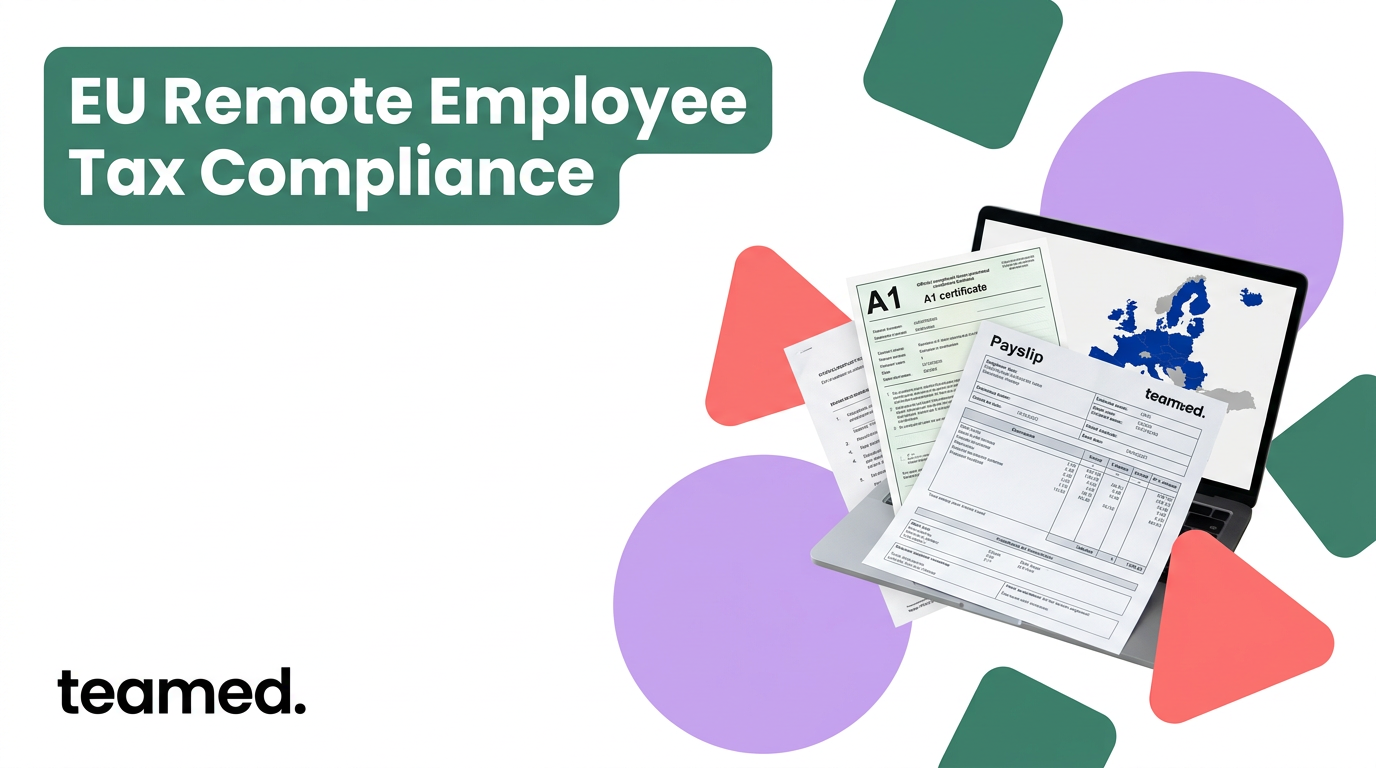
How do we ensure tax compliance when paying remote employees across multiple EU countries?
Your German engineer works from Berlin. Your marketing lead splits time between Paris and Barcelona. Your product manager just relocated to Amsterdam. Each location triggers different payroll withholding rules, social security obligations, and potential corporate tax exposure for your company.
Tax compliance for remote employees in the EU means correctly registering, calculating, withholding, reporting, and paying payroll taxes and social security in each country where your employees legally work. Get it wrong, and you're facing back taxes, penalties, and the kind of audit that keeps HR directors awake at night.
The challenge isn't just understanding the rules. It's building operational systems that track where people actually work, determine which country's social security applies, and ensure your payroll runs correctly in each jurisdiction. Most mid-market companies discover this complexity only after an employee relocates or a tax authority sends a letter.
Quick Facts: EU Remote Employee Tax Compliance
If an employee spends more than 183 days in an EU country, they typically become a tax resident and must declare income there as their home taxation base.
EU social security coordination is governed by Regulation (EC) No 883/2004, meaning social security for cross-border workers is determined by coordination rules rather than employer preference.
An A1 certificate confirms which country's social security legislation applies to a worker temporarily working in another EU member state, and should be obtained before or at the start of any cross-border assignment.
Remote workers can trigger permanent establishment risk for their employer, potentially creating corporate tax obligations in the country where they work.
Germany's wage tax (Lohnsteuer) requires local payroll processing when an employee is employed in Germany, making compliant local payroll setup essential.
France requires employers to operate payroll withholding (PAS) and pay French social contributions through the French payroll reporting system.
Spain requires payroll withholding for personal income tax (IRPF) and payment of Spanish social security contributions for employees employed in Spain.
What are the three compliance tracks for EU remote employment?
Most guidance on EU remote employee tax compliance conflates three distinct obligations that have different triggers and require different evidence. Understanding these separately is the foundation of any compliance strategy.
Income tax withholding obligations are typically triggered by where work is physically performed. If your employee works from Germany, German income tax rules apply to that work, regardless of where your company is headquartered. This means you need either a German payroll registration or an Employer of Record arrangement to handle withholding correctly.
Social security affiliation follows EU coordination rules under Regulation 883/2004, not payroll location. An employee working in France for a UK employer might remain on UK social security if they're temporarily posted and have an A1 certificate, particularly when telework is under 50% of total working time. The A1 is your evidence that you're paying contributions to the right country and not double-paying.
Corporate permanent establishment risk is separate from both. When employees work remotely in a country where you have no entity, their activities could create a taxable presence for your company. An employee who habitually concludes contracts or has authority to bind your company can trigger PE exposure, creating corporate income tax obligations you never anticipated.
How does the 183-day rule actually work across EU countries?
The 183-day threshold appears in most EU tax treaties, but applying it correctly is more nuanced than counting calendar days. HR leaders on Reddit frequently describe confusion about whether the rule applies per calendar year, per rolling twelve months, or per tax year, and the answer varies by country.
Germany counts days within the calendar year. France uses a rolling twelve-month period. The Netherlands applies the rule per calendar year but has additional tests around habitual abode and centre of vital interests. When an employee works across multiple EU countries, you need to track days in each jurisdiction separately and understand each country's specific interpretation.
The practical implication is that you can't manage this with a spreadsheet and good intentions. You need a system of record that captures work location, days-in-country, employing entity, A1 status, and payroll registration status for each employee. Without this data infrastructure, you're making compliance decisions blind.
Teamed's analysis of mid-market companies managing EU remote teams shows that location tracking failures are the leading cause of missed withholding deadlines and late payroll registrations. The companies that get this right treat location data as a compliance control, not an HR convenience.
What triggers payroll registration requirements in each EU country?
Each EU country has its own threshold for when a foreign employer must register for payroll. In most cases, having even one employee working in-country triggers registration requirements, though enforcement varies significantly.
Germany requires payroll registration when you employ someone working in Germany, full stop. You'll need a German payroll number (Betriebsnummer) and must process payroll according to German conventions, including delivering payslips in the required format. The German authorities are efficient at identifying non-compliance through cross-referencing social security and tax records.
France similarly requires employers to operate payroll withholding and pay French social contributions through the French reporting system. The French system is particularly unforgiving of late registration, and penalties accumulate quickly. Companies without a French entity typically need an EOR arrangement to employ French-resident workers compliantly.
Spain requires payroll withholding for IRPF and payment of Spanish social security contributions. Employers must align contract terms and payroll classifications to Spanish statutory categories, which differ from UK or US conventions. Getting the job category wrong can result in incorrect contribution rates and subsequent audits.
The pattern is consistent: if someone works in an EU country, that country expects you to run compliant local payroll. The question is whether you do this through your own entity, through an EOR, or through shadow payroll arrangements where appropriate.
When should you use an Employer of Record versus establishing your own entity?
Choose an EOR when you need to employ a worker in an EU country within weeks and you don't have, or don't want to set up, a local employing entity and payroll registrations in that country. The EOR becomes the legal employer, handling local payroll, statutory withholdings, and compliance while you direct day-to-day work.
Choose an owned entity when you plan to build a sustained in-country presence and need direct control over payroll, benefits design, equity plans, and local HR policies under your own legal employer. Based on Teamed's work with over 1,000 companies on global employment strategy, the economics typically shift toward entity establishment when you reach 15-20 employees in a single EU country, though this varies by jurisdiction complexity and the fact that 91.9% of large enterprises now provide full remote access capabilities.
The Graduation Model provides a framework for these decisions. Companies typically progress from contractor arrangements (for testing markets) to EOR (when compliance requirements tighten) to owned entities (when headcount justifies the investment). The key is having a partner who advises on when the economics and risk profile shift, not one incentivised to keep you on EOR indefinitely.
Teamed's published EOR fee of $599 per employee per month provides a predictable baseline for comparing EOR versus entity costs. When you're modelling the crossover point, include not just the monthly fees but also the entity setup costs, ongoing compliance overhead, and the management time required to coordinate multiple local providers.
How do A1 certificates protect against double social security contributions?
An A1 certificate is your evidence that an employee remains subject to their home country's social security legislation while temporarily working in another EU/EEA/Switzerland member state. Without it, you risk paying social contributions in both countries, and the employee risks gaps in their coverage.
The A1 applies when an employee is temporarily posted to another member state while maintaining attachment to the home social security system. The posting must be genuinely temporary, typically up to 24 months, though extensions are possible. The employee must have been subject to the home country's legislation immediately before the posting began.
Obtaining the A1 before or at the start of the assignment is critical. Retroactive applications are possible but create audit risk and administrative complications. Teamed assigns named jurisdiction specialists within 48 hours specifically because A1 applications require country-specific expertise and timing matters.
A1 certification differs from a visa or work permit because A1 only governs social security affiliation, while immigration permission governs the right to live and work in the country. You need both, and they're obtained through entirely different processes with different authorities.
What is shadow payroll and when do you need it?
Shadow payroll is a compliance mechanism used when an employee remains employed by a foreign entity but has local tax withholding obligations in the work country. You run a "shadow" calculation of what local taxes would be, report and withhold accordingly, but the actual employment relationship and primary payroll remain with the home country employer.
You typically need shadow payroll when an employee works in a country for long enough to trigger local tax obligations but remains employed by your entity elsewhere. This often happens with extended business travel, temporary assignments, or employees who split time between countries.
Shadow payroll differs from standard payroll because it reports and withholds local tax for a foreign-employed worker without changing the employing entity. Standard payroll is run by the legal employer in-country. The distinction matters because shadow payroll is a tax compliance mechanism, not an employment structure.
Most competitor articles avoid explaining shadow payroll in practical terms. The decision rules are straightforward: if your employee has local tax withholding obligations but you're not changing their employing entity, shadow payroll is likely your compliance route. Local tax advisers should confirm this is the expected approach before you implement.
How do you prevent permanent establishment exposure from remote workers?
Permanent establishment risk arises when a company becomes subject to local corporate income tax because it has a sufficient fixed place of business or a dependent agent habitually concluding contracts in a country. Remote employees can inadvertently create this exposure.
The risk is highest when employees have authority to bind your company. A sales director who negotiates and signs contracts from their home in Spain could create Spanish PE exposure for your UK company. A country manager who makes operational decisions from Germany could trigger German corporate tax obligations.
PE risk differs from payroll withholding risk because PE is a corporate tax exposure linked to business presence and authority, while payroll withholding is an employment tax obligation linked to remuneration for work performed locally. You can have payroll obligations without PE risk, and you can have PE risk even with compliant payroll.
Managing this requires clear policies on what activities employees can perform remotely and where. Many companies implement country gating rules that require approval before an employee can work from a new location. The approval process should include PE risk assessment alongside payroll and social security considerations.
What operational controls prevent EU tax compliance failures?
The companies that consistently get EU remote employee tax compliance right share common operational characteristics. They treat compliance as a system, not a series of one-off decisions.
First, they maintain a system of record with essential fields: work location, days-in-country, employing entity, A1 status, PE risk rating, payroll registration status, and filing calendar. This data model is audit-ready and enables proactive compliance rather than reactive firefighting.
Second, they define clear RACI ownership. HR owns location tracking and employee communication. Finance owns payroll registration and tax filing. Legal owns PE risk assessment and structure decisions. The EOR or payroll partner owns execution within their scope. Without clear accountability, compliance gaps emerge at handoff points.
Third, they implement standardised country gating rules. When an employee requests to work from a new location, the approval process includes compliance assessment. Location-by-location exceptions are a leading cause of missed withholding and late payroll registrations in cross-border employment.
Teamed reports 99% logo retention, which suggests that ongoing multi-country compliance operations are a long-term need rather than a short implementation project. The operational infrastructure you build now will serve you as your EU footprint grows.
What should you do if you're already non-compliant?
If you've discovered employees working in EU countries without proper payroll registration or tax withholding, you have options, but speed matters. Most EU tax authorities have voluntary disclosure programmes that reduce penalties for companies that come forward before being caught.
Start by mapping your actual exposure. Where are employees actually working? For how long? What payroll and social security obligations have you missed? This assessment determines the remediation path.
For ongoing employment, you typically need to establish compliant payroll immediately. An EOR can often onboard employees within 24 hours, which materially reduces the compliance gap between discovering the problem and being correctly on local payroll. Teamed states it can onboard hires in as little as 24 hours specifically for situations where speed matters.
For historical exposure, work with local tax advisers to determine whether voluntary disclosure makes sense. The calculation involves potential penalties, interest, and the likelihood of detection. In most cases, proactive disclosure results in better outcomes than waiting for an audit.
Building a sustainable EU remote employment compliance strategy
Tax compliance for remote employees across multiple EU countries isn't a problem you solve once. It's an operational capability you build and maintain as your workforce evolves.
The right structure for where you are today may not be the right structure in eighteen months. A company with three employees in Germany might use EOR. At fifteen employees, entity establishment often makes more economic sense. The Graduation Model provides a framework for these transitions, ensuring you're always in the appropriate structure without the disruption of switching providers at each stage.
The honest answer is that EU remote employment compliance is genuinely complex. Anyone who tells you otherwise is selling simplicity that hides real risk. But complexity doesn't mean impossible. It means you need the right operational infrastructure, clear accountability, and expert support when situations get nuanced.
If you're managing remote employees across multiple EU countries and want to understand whether your current structure is right for where you're going, talk to an expert who can assess your specific situation and advise on the path forward.